






















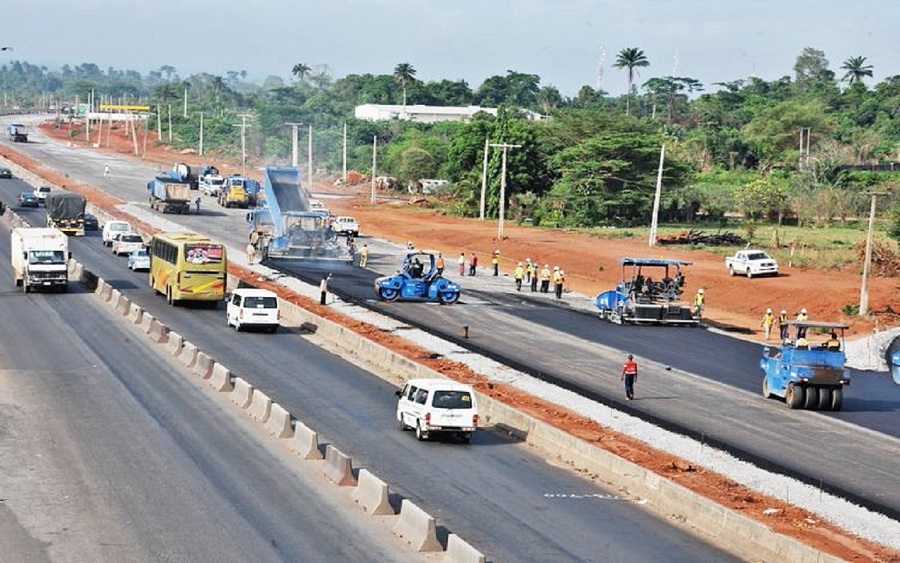
The Federal Government has earmarked ₦367.9 billion in loan financing for the construction and dualisation of the Lafia Road and the 9th Mile (Enugu)–Otukpo–Makurdi corridor in the proposed ₦58.47 trillion 2026 budget, underscoring its continued reliance on external funding to advance capital-intensive road infrastructure. The allocation, captured in the 2026 Appropriation Bill (Details), ranks among the largest single items under the Federal Ministry of Works, reflecting the strategic importance of the corridor to interregional trade and mobility.
According to the budget documents, the Ministry of Works received a total allocation of ₦3.49 trillion for 2026, with ₦3.44 trillion dedicated to capital expenditure. This heavy tilt toward capital spending signals the government’s priority to accelerate ongoing road construction, rehabilitation, and dualisation projects nationwide, even as fiscal pressures persist.
What the Appropriation Bill shows
The Lafia Road and 9th Mile–Otukpo–Makurdi project appears in the bill under project code ERGP12234171 as a multilateral/bilateral tied loan, with a proposed allocation of ₦367,902,737,115. The scope covers the construction of Lafia Road and the dualisation of the 9th Mile (Enugu)–Otukpo–Makurdi route under Keffi Phase II, a vital artery linking the North-Central and South-East regions.
The size and structure of the allocation indicate that the project will be funded predominantly through external borrowing rather than direct treasury releases. This approach has become a standard model for large federal highways, where budgetary allocations alone are insufficient to meet rising construction costs driven by inflation, currency pressures, and security-related disruptions. The project is classified as ongoing, placing it among a cluster of long-term works being supervised by the Ministry of Works.
Other major road projects in the 2026 budget
Beyond the Lafia–Makurdi corridor, the 2026 budget contains sizeable provisions for several high-impact road projects. These include ₦52.5 billion for Phase II of the Kano–Katsina Road dualisation and ₦23.8 billion for Phase I of the same corridor. Multinational counterpart projects—such as the Lafia Bypass and components of the 9th Mile–Otukpo–Makurdi Road—also received ₦23.8 billion, reflecting the co-financing structure often required by development lenders.
Additional allocations include ₦13.3 billion for the Kano–Maiduguri Road (Kano–Wudil–Shuarin section), ₦12.6 billion for the Ikorodu–Itoikin Road in Lagos State, and ₦7.7 billion for the Abuja–Lokoja Road (Zuba–Abaji section). The Ikot Ekpene border–Aba–Owerri dualisation was allotted ₦7.7 billion, while the Numan–Jalingo Road rehabilitation received ₦7.0 billion.
Further details show ₦7.0 billion for the Damaturu–Maiduguri section of the Kano–Maiduguri Road and ₦7.01 billion for Section 3 of the Mubi–Maiduguri Road. The ministry also set aside ₦100 billion for a contingency fund and ₦600 billion for proposed new projects across the six geopolitical zones, though specific project details were not disclosed in the bill.
Why this matters
Nigeria’s federal road network—estimated at over 35,000 kilometres—has long suffered from underfunding and deferred maintenance. Officials have repeatedly acknowledged that annual budgets cannot, on their own, close the infrastructure gap. In this context, loan-backed financing has become central to sustaining progress on strategic corridors that support agriculture, industry, and trade.
Projects financed through multilateral and bilateral loans are typically paired with cost-recovery mechanisms such as tolling to ensure long-term sustainability. The Lafia–9th Mile–Makurdi corridor fits this model, given its role in connecting key economic zones and easing logistics across regions.
What you should know
The Federal Government, under Bola Tinubu, has increasingly adopted blended financing—combining budgetary funds, loans, and private capital—to fast-track infrastructure delivery. Notable examples include the Benin–Asaba Superhighway, advanced through private-sector funding, and the Lagos–Calabar Coastal Highway, which secured $747 million in July 2025 and an additional $1.2 billion in December 2025.
Within this broader strategy, the ₦367.9 billion loan allocation for the Lafia Road and 9th Mile–Otukpo–Makurdi dualisation stands out as a cornerstone investment in 2026—one that highlights both the scale of Nigeria’s infrastructure ambitions and the growing role of external financing in turning those plans into reality.

Emmanuel Bassey is a Financial Expert that has worked in the Banking and Finance Industry for over 15+ years across different banks in Nigeria


