




























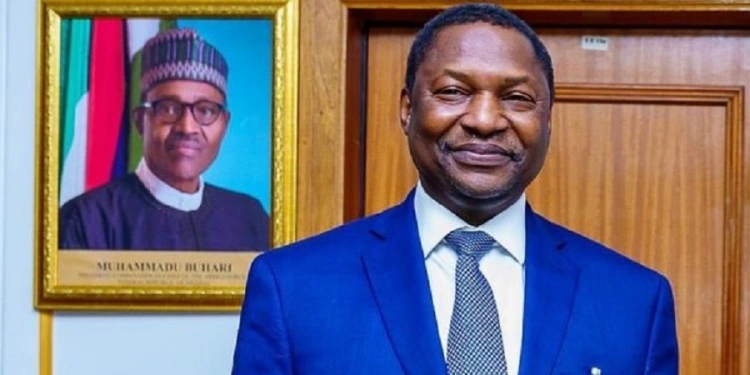
A Federal High Court sitting in Abuja has ordered the interim forfeiture of 57 properties valued at N213.2 billion, allegedly linked to former Attorney-General of the Federation (AGF) and Minister of Justice, Abubakar Malami (SAN), and two of his sons. The ruling marks a significant escalation in one of Nigeria’s most high-profile corruption and asset recovery cases in recent years.
The interim forfeiture order was granted on Tuesday, January 6, 2026, following an application filed by the Economic and Financial Crimes Commission (EFCC). According to the anti-graft agency, the assets are reasonably suspected to be proceeds of unlawful activities and are therefore subject to temporary forfeiture pending the outcome of ongoing investigations and court proceedings.
The development was disclosed in an official statement issued by the EFCC on Wednesday through its verified X (formerly Twitter) account. The commission explained that the order was granted after Justice Emeka Nwite considered and approved an ex parte motion filed by EFCC’s legal team, led by senior advocate Ekele Iheanacho (SAN).
Court directives and legal process
In granting the interim forfeiture, Justice Nwite directed that the order be published in a national daily newspaper. This publication, the court said, is intended to notify any individual or corporate entity with a legal interest in the affected properties, giving them 14 days to appear before the court and show cause why the assets should not be permanently forfeited to the Federal Government.
The judge further adjourned the matter to January 27, 2026, for a report on compliance with the court’s directives, particularly the publication requirement. The court emphasized that the interim forfeiture does not amount to a final determination of guilt but is a procedural step designed to preserve the assets while investigations and trial processes continue.
According to the EFCC, the forfeited properties are “reasonably suspected to be proceeds of unlawful activities,” a standard threshold required under Nigerian law for interim forfeiture orders in financial crime cases.
Scope and nature of the properties
The 57 properties, with a combined estimated value of N213,234,120,000, are spread across Abuja, Kebbi, Kano, and Kaduna States. They comprise a wide mix of residential, commercial, and industrial assets, reflecting significant diversification in the property portfolio allegedly linked to Malami and his family members.
Among the notable assets listed in the court filings are luxury residential properties in highbrow areas of Abuja, including a luxury duplex on Amazon Street, Maitama, reportedly purchased in December 2022 for N500 million and now valued at N5.95 billion. Another major asset is a two-winged, large storey building on Onitsha Crescent, Garki, Abuja, acquired in December 2018 for N7 billion.
Commercial assets include Meethaq Hotels Ltd in Jabi, Abuja, a five-storey hotel with 53 rooms, purchased in September 2020 for N850 million and currently valued at N8.4 billion, as well as a 15-room hotel on Rhine Street, Maitama, bought in February 2018 for N430 million and now estimated at N12.95 billion.
Outside Abuja, the properties also include 100 hectares of land along Birnin Kebbi–Jega Road, purchased in 2020 for N100 million, alongside various shops, warehouses, residential buildings, schools, pharmacies, supermarkets, oil and gas filling stations, and commercial plazas acquired between 2016 and 2024. Collectively, these assets run into several billions of naira.
Broader legal context
The EFCC noted that the interim forfeiture order is connected to ongoing money laundering charges involving Malami, his wife Bashir Asabe, and one of his sons, Abdulaziz Malami, relating to alleged financial crimes totaling N8.7 billion. The commission said the asset recovery process is part of its broader mandate to trace, freeze, and recover proceeds of crime, regardless of the status or former position of those involved.
Malami’s camp has, however, pushed back strongly against the EFCC’s actions, describing them as “brazen, contemptuous, and lawless.” The anti-graft agency has rejected these claims, insisting that all its actions are grounded in law and backed by court orders.
What you should know
Malami is reportedly being investigated for at least 18 alleged offences, including money laundering and abuse of office. He has also alleged that the EFCC’s actions are retaliatory, a claim the commission maintains is unfounded.
The case follows earlier high-profile prosecutions involving former Attorneys-General, including Mohammed Bello Adoke, who was discharged in 2024 after a no-case submission was upheld by the court. In the ongoing trial, the Federal High Court has previously granted Malami, his wife, and his son N1.5 billion bail in relation to the N8.7 billion money laundering charges.
As the legal process unfolds, the interim forfeiture order represents a major milestone, underscoring the growing use of asset tracing and recovery as a central tool in Nigeria’s anti-corruption framework.

Emmanuel Bassey is a Financial Expert that has worked in the Banking and Finance Industry for over 15+ years across different banks in Nigeria


