



















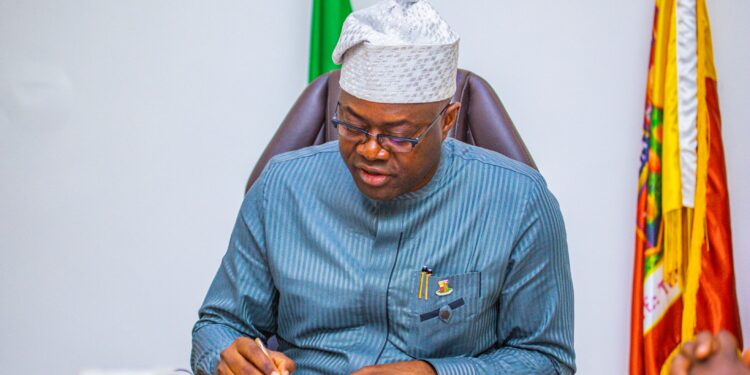
Oyo State Governor, Seyi Makinde, has signed the state’s N892 billion 2026 Appropriation Bill into law, officially setting the fiscal direction for another year of aggressive infrastructure expansion and sustained social sector investment. The signing ceremony, held on Monday at the Executive Chamber in Ibadan, marked the culmination of a budget process that state officials described as timely, disciplined, and reflective of evolving economic realities.
The event drew top government functionaries, members of the State Executive Council, and lawmakers from the Oyo State House of Assembly, who commended the administration for maintaining consistency in its budgeting calendar. Observers noted that early passage and assent have become a defining feature of the Makinde government’s fiscal management style, enabling MDAs to commence implementation without delays that often undermine public projects.
Speaking at the ceremony, Governor Makinde said the 2026 budget was anchored on realism and fiscal discipline, stressing that expenditure projections were closely aligned with achievable revenue targets. He reiterated his administration’s determination to further strengthen internally generated revenue (IGR) as a buffer against volatility in federal allocations. According to him, ministries, departments and agencies must fully align with the established implementation framework to ensure value for money and timely project delivery.
In a significant policy signal, the governor hinted that Oyo State could cross the symbolic N1 trillion budget threshold in 2026 if revenue performance exceeds projections. He explained that the government would not hesitate to approach the legislature with a supplementary appropriation should inflows outperform expectations. “If we experience a windfall or exceed our targets, we will send a supplementary budget so that critical developmental projects can be adequately funded,” Makinde said. If realised, such a move would place Oyo among a small group of subnational governments operating trillion-naira fiscal plans, underscoring its growing economic ambition.
The legislature, for its part, welcomed the governor’s approach. Speaker of the House, Adebo Ogundoyin, praised the executive–legislative harmony that ensured smooth passage of the budget. He said lawmakers adhered to global best practices in public finance management, emphasising transparency, predictability and accountability throughout the budget cycle. Ogundoyin added that the House would intensify its oversight responsibilities in 2026 to ensure that appropriated funds translate into tangible benefits for residents across all zones of the state.
With the budget now in force, implementation begins immediately, ushering the Makinde administration into its seventh fiscal year with renewed momentum. Analysts say the size of the 2026 budget reflects both confidence in the state’s revenue outlook and a willingness to leverage public spending as a catalyst for economic growth, job creation and service delivery.
The N892 billion budget also represents the latest milestone in Oyo State’s steadily expanding fiscal framework since Governor Makinde assumed office. Over the years, the state has transitioned from cautious consolidation to more assertive development spending, with a strong focus on infrastructure renewal, education, healthcare and revenue mobilisation.
This shift became more pronounced in the 2024 fiscal year, when the administration proposed a N434.4 billion budget, almost evenly split between capital and recurrent expenditure. Education took the largest share, followed by infrastructure and health, reflecting a deliberate emphasis on human capital development. The government also set ambitious IGR targets to reduce reliance on federal transfers.
By 2025, Makinde signed into law a N684.15 billion “Budget of Stabilisation,” representing a sharp year-on-year increase of more than 57 percent. Capital expenditure slightly outweighed recurrent spending, reinforcing the administration’s growth-oriented posture. Infrastructure again dominated allocations, with major funding directed at road networks and strategic transport corridors. Mid-year adjustments were also approved to accelerate priority projects, including the 48-kilometre Ido–Ibarapa Road, highlighting the government’s readiness to recalibrate spending in line with development timelines.
Against this backdrop, the 2026 budget—and the possibility of a supplementary push toward N1 trillion—signals Oyo State’s intent to consolidate its position as one of Nigeria’s more fiscally ambitious and reform-driven subnational economies.

Emmanuel Bassey is a Financial Expert that has worked in the Banking and Finance Industry for over 15+ years across different banks in Nigeria


