Creator
  • Type:
  • Genre:
  • Duration:
  • Average Rating:
Log In
 
  • Marketplace
Log In
 
  • Type:
  • Genre:
  • Duration:
  • Average Rating:
  • Marketplace

Crime

NDLEA Arrests Brazilian Woman with N3 Billion Worth of Heroin at Abuja Airport

  • dollaers
  • January 26, 2026
  • Crime
  • 0 comments

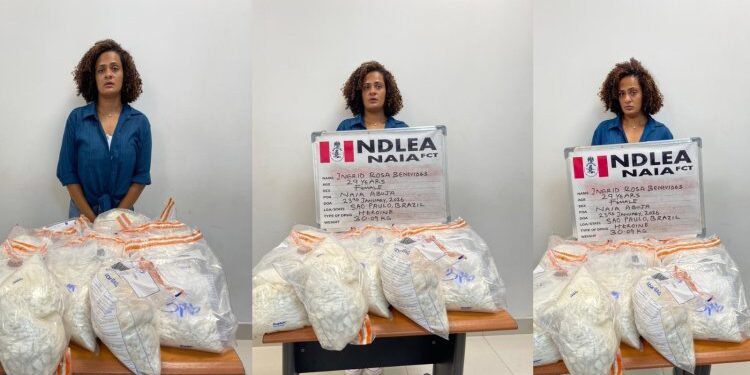
The National Drug Law Enforcement Agency (NDLEA) has arrested a Brazilian national, Ingrid Rosa Benevides, for attempting to smuggle heroin valued at over N3 billion into Nigeria through the Nnamdi Azikiwe International Airport, Abuja.

The arrest, which took place on Friday, January 23, 2026, was confirmed in a statement issued by the NDLEA’s Director of Media and Advocacy, Femi Babafemi. According to the agency, the operation was intelligence-led and formed part of intensified surveillance at Nigeria’s international entry points.

Benevides, a 30-year-old private security officer based in Brazil, arrived in Abuja aboard Qatar Airways flight QR1431 from Brazil. During routine inspection, NDLEA operatives flagged her two checked-in bags for further examination after discovering 21 factory-sealed packs of Brazilian coffee.

Although the items appeared sealed and legitimate, a detailed search revealed that the coffee packs did not contain coffee. Instead, NDLEA officers uncovered a white substance concealed inside the packs, which laboratory tests later confirmed to be heroin.

The total weight of the seized drug was 30.09 kilograms, with the NDLEA estimating its street value at over N3 billion.

“A total of 30.09 kilograms of white heroin concealed in factory-sealed coffee packs worth over N3 billion in street value was recovered,” the agency said.

During preliminary interrogation, Benevides reportedly claimed that she travelled to Nigeria under the guise of visiting for holidays. She is currently in NDLEA custody as investigations continue.

Airport and border interceptions

The NDLEA also reported a series of related drug interdictions across the country within the same period, underscoring what it described as sustained pressure on drug trafficking networks.

At the Murtala Muhammed International Airport, Ikeja, operatives intercepted two passengers—Adediran Adedoyin and Afatakpa Ochuko—on Tuesday, January 20, while they were attempting to board a flight to Istanbul, Turkey. A search of their luggage led to the recovery of 3,990 pills of tapentadol and tramadol, concealed inside food items.

In Lagos, officers of the NDLEA Marine Command intercepted a wooden boat conveying 44 jumbo bags of Ghana Loud cannabis, weighing 1,848 kilograms, at Jakande Beach, Lekki, in the early hours of Thursday, January 22.

The agency also confirmed the arrest of Aminu Ali Baba and Abdulrasheed Abubakar in connection with the interception of 140 packets of explosives being transported to Kano and Kaduna. The explosives were initially intercepted along the Kaduna–Zaria highway, while follow-up operations led to the arrest of the suspects in both states.

In Borno State, NDLEA operatives intercepted 179,590 pills of tramadol and diazepam hidden inside sacks of charcoal and animal feed in a commercial vehicle coming from Yobe State. Further investigation led to the arrest of the owner of the consignment, Rabiu Imam.

Nationwide raids

Beyond airports and highways, the NDLEA said it carried out multiple raids across several states, leading to arrests and large seizures of illicit substances. These include:

  • The arrest of a 72-year-old suspect, Afolalu Joseph, in Ekiti State, with 62 kilograms of skunk

  • The arrest of an Edo village head, Chief James Abamu, alongside another suspect, with 681 kilograms of skunk and 181 kilograms of cannabis seeds

  • The seizure of significant quantities of tramadol, skunk, pentazocine injections, codeine syrup, and other illicit drugs in Lagos, Oyo, Delta, Benue, Niger, Kwara, the FCT, Kano, Ondo, and Jigawa States

The agency said several suspects remain in custody, while investigations and prosecutions are ongoing nationwide.

What you should know

The arrest of the Brazilian national highlights a recurring pattern of foreign-linked drug trafficking attempts at Nigeria’s international airports.

In October 2024, NDLEA operatives arrested a Thailand returnee at the Lagos airport with 13.30 kilograms of heroin valued at over N3.1 billion, concealed in backpacks inside suitcases. In the same month, a Canada-based nurse and two businessmen were arrested with 35.7 kilograms of synthetic cannabis (Canadian Loud), alongside cocaine recovered from a suspect who had ingested the drug.

Earlier in 2025, the agency also arrested multiple suspects at the Lagos and Port Harcourt airports, including passengers found to have ingested wraps of heroin that were later recovered following body scans and observation.

According to the NDLEA, these cases reflect the scale and sophistication of transnational drug trafficking networks targeting Nigeria, and reinforce the agency’s commitment to tightening border security and disrupting illicit drug supply chains.

Europol Arrests 10 Nigerians in Spain-Led ‘Black Axe’ Crackdown Over €5.93 Million Fraud

  • dollaers
  • January 13, 2026
  • Crime
  • 0 comments

European law enforcement authorities have arrested 10 Nigerians as part of a major international operation targeting the notorious ‘Black Axe’ criminal network, with estimated fraud losses exceeding €5.93 million. The arrests were carried out in Spain and form part of a broader sweep that saw a total of 34 suspects detained in connection with the organised crime group.

The development was disclosed in an official statement published by Europol, which detailed the outcome of a coordinated cross-border operation involving Spanish and German security agencies. According to Europol, the action focused on dismantling what investigators described as the core leadership and financial facilitators of the Black Axe network operating across Europe.

The operation was led by the Spanish National Police, working closely with the Bavarian State Criminal Police Office in Germany, with Europol providing analytical, intelligence, and operational support. Authorities said the investigation spanned several months and relied heavily on intelligence sharing, data analysis, and real-time coordination between the participating countries.

In its statement, Europol described Black Axe as a highly structured and hierarchical international criminal organisation with origins in Nigeria and an operational footprint across dozens of countries worldwide. The agency said the group is involved in a broad spectrum of criminal activities, including cyber-enabled fraud, drug trafficking, human trafficking, prostitution, kidnapping, armed robbery, and fraudulent spiritual practices.

“The Spanish National Police, in close cooperation with the Bavarian State Criminal Police Office and with the support of Europol, has conducted an operation against the international criminal organisation ‘Black Axe’,” Europol said. “The action resulted in 34 arrests and significant disruption to the group’s activities. The core group of arrested suspects consists of 10 individuals of Nigerian nationality.”

Investigators revealed that the arrests were concentrated in southern and central Spain. Twenty-eight suspects were detained in Seville, while others were apprehended in Madrid, Málaga, and Barcelona. During coordinated house searches, law enforcement officers froze €119,352 held in bank accounts and seized €66,403 in cash believed to be linked to the group’s criminal proceeds.

Europol said the Black Axe network generated billions of euros annually through numerous small-scale but highly organised fraud schemes. While individual scams often involved relatively modest sums, the cumulative impact caused significant financial harm to victims across Europe and beyond.

Further details from the agency highlighted the group’s heavy reliance on so-called money mules. These individuals, often recruited from economically vulnerable communities with high unemployment rates, were used to move illicit funds and obscure the origins of fraud proceeds. Europol noted that many of the money mules involved in this case were Spanish nationals who were exploited by the criminal network to funnel illegal funds through legitimate-looking local transactions.

The cross-border operation also involved the deployment of German officers to Spain during the action phase, underscoring the level of cooperation required to dismantle a fragmented and transnational criminal structure. Europol said it supported the investigation through advanced information analysis, a dedicated data sprint held in Madrid, and real-time coordination between national authorities during the arrests.

Providing historical context, Europol linked Black Axe to the Neo-Black Movement of Africa, noting that the group operates through a zonal structure both within Nigeria and internationally. According to the agency, the organisation has thousands of registered members and affiliated facilitators worldwide, making it one of the most complex and resilient criminal networks operating across borders.

The latest crackdown is part of a broader global effort to curb the activities of Black Axe and similar transnational groups. In a major coordinated operation led by Interpol between April and July 2024, more than 300 individuals linked to the Nigerian-founded network were arrested across 21 countries. That operation, codenamed Jackal III, exposed the group’s extensive use of cybercrime tools and cryptocurrency for money laundering.

Earlier enforcement actions have also yielded significant results. In November 2023, Irish authorities seized over €1 million in crypto-assets, confiscated more than $3 million in other illegal proceeds, and froze over 700 bank accounts tied to the network. According to Europol, these cumulative efforts have helped law enforcement agencies build a shared intelligence database across Interpol’s 196 member countries.

Europol said the latest operation was designed to weaken Black Axe by disrupting its leadership, dismantling its financial networks, and seizing criminal assets. Authorities stressed that sustained international cooperation remains critical, given the group’s ability to adapt quickly and exploit jurisdictional gaps. As investigations continue, further arrests and asset seizures are expected as European and global agencies intensify pressure on the network’s remaining cells.

Forgot Password
Please enter your email address or username below.
*
 
Login
*
*
Lost Your Password
Dont have account? Signup