





















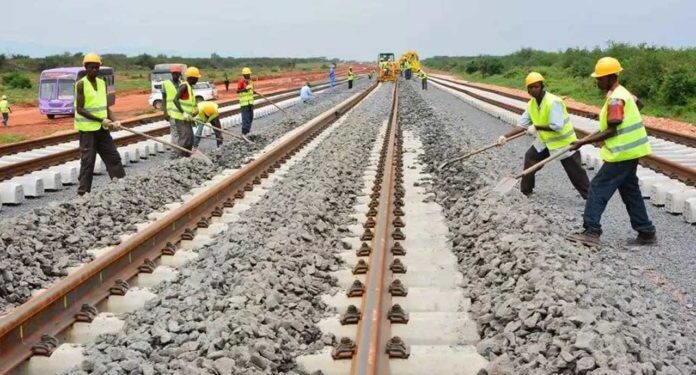
The Federal Government has proposed a total allocation of N102.3 billion as counterpart funding for the Lagos Green Line rail project in the 2026 fiscal year, reinforcing its commitment to expanding Nigeria’s urban rail infrastructure. The proposed allocation is contained in the 2026 Appropriation Bill under the Ministry of Transportation.
The Lagos Green Line is a major rail infrastructure project designed to improve mobility across key commercial and residential districts in Lagos. The proposed rail corridor spans approximately 68 kilometres, running from the Lekki Free Zone to Marina, and is expected to serve high-density areas such as Victoria Island, Lekki, Ajah, and Sangotedo.
According to budget details, the 2026 allocation is specifically targeted at Phase One of the Lagos Green Line Metro Rail project. The funds are to be transferred to the Ministry of Finance Incorporated (MOFI), an agency responsible for managing federal equity participation, counterpart funding, and structured financing arrangements for large-scale infrastructure developments.
The funding model indicates continued reliance on structured financing frameworks that are expected to involve collaboration between the Federal Government, the Lagos State Government, and other domestic or international financiers. This approach reflects the scale and capital-intensive nature of the Green Line project, which has been estimated to cost around $3 billion upon completion.
In comparison, the Federal Government proposed a higher counterpart funding of N146.14 billion for the same project in the 2025 budget, suggesting a recalibration of funding requirements as project planning progresses. Despite the reduction, the sustained allocation signals ongoing federal backing while implementation plans are being finalised.
Beyond the Lagos Green Line, the 2026 budget outlines additional investments across Nigeria’s rail sector. The Federal Government plans to spend N68.5 billion on consultancy services related to the proposed Lekki–Ijebu Ode–Ore–Kajola railway as well as the coastal rail corridor linking Badagry, Apapa, and Tin Can ports. These consultancy services are expected to cover feasibility assessments, design reviews, and project structuring activities.
The budget also earmarks N29.04 billion for various ongoing and planned railway modernisation projects nationwide. These include the completion of the Abuja–Kaduna railway, further development works on the Lagos–Ibadan rail line, and the rehabilitation of the Itakpe–Ajaokuta rail corridor. Additional provisions cover the construction of 12 railway station buildings and track-laying works at ancillary rail facilities in Agbor.
Further allocations under the same budget line include funding for the design, manufacture, and installation of rolling stock, alongside the supply of spare parts and maintenance equipment. The proposal also includes investments in signalling and telecommunications systems on the Itakpe–Ajaokuta–Warri rail line, as well as the deployment of acoustic sensing security surveillance systems on the Abuja–Kaduna corridor to enhance rail safety.
The 2026 budget additionally makes room for feasibility studies for new standard-gauge rail lines and the engagement of transaction advisers for the planned concession of major routes such as the Abuja–Baro–Itakpe, Aladja–Warri Port, and Kano–Maradi rail projects.
The Lagos Green Line itself is envisioned as a modern, high-capacity urban transit system featuring 17 stations along a mix of elevated and at-grade tracks. Planned amenities include pedestrian bridges, elevators, escalators, and a dedicated depot near Sangotedo. Trains are expected to operate in eight-car sets, reach speeds of up to 100 km/h, and move up to 35,000 passengers per hour per direction at peak capacity.
While construction was initially scheduled to begin in December 2025 following extensive feasibility studies and stakeholder consultations along the Lekki–Epe corridor, work had not commenced as of January 2026. However, planning and coordination activities remain ongoing.
Some transport experts have expressed concerns over station spacing and operational capacity, particularly in Victoria Island and along the Lekki axis. They have recommended the addition of more stations in high-traffic areas and stronger integration with existing rail lines to maximise ridership and efficiency.
Overall, the proposed 2026 allocation underscores the Federal Government’s continued interest in expanding rail infrastructure, even as timelines and funding structures evolve.

Emmanuel Bassey is a Financial Expert that has worked in the Banking and Finance Industry for over 15+ years across different banks in Nigeria


