


























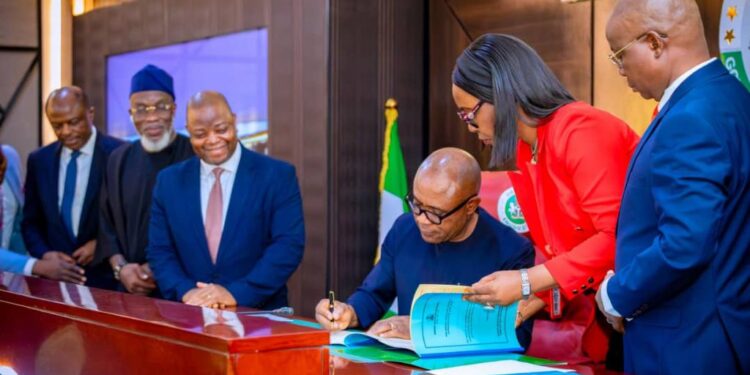
Governor Peter Mbah has signed the Enugu State 2026 Appropriation Bill into law, formally ushering in a new fiscal year defined by aggressive revenue mobilisation, institutional reforms, and accelerated development spending. The signing ceremony took place on Wednesday at the Enugu State Government House, shortly after the bill was swiftly passed by the State House of Assembly, underscoring a rare level of alignment between the executive and legislative arms of government.
With the governor’s assent, the 2026 budget takes immediate effect, positioning it as a continuation—and deepening—of the reforms initiated by the Mbah administration since assuming office. According to the governor, the new fiscal plan is designed to consolidate earlier gains, scale up infrastructure delivery, and entrench a governance culture anchored on efficiency, accountability, and long-term sustainability.
Speaking after signing the bill, Mbah said the 2026 budget is firmly rooted in principles of inclusivity, transparency, accountability, traceability, and the strengthening of institutions to ensure that every naira of public spending delivers value to residents. He emphasised that fiscal discipline and clear performance benchmarks would guide implementation across all ministries, departments, and agencies.
Central to the 2026 fiscal framework is an ambitious Internally Generated Revenue (IGR) target of N870 billion, a figure that would represent a dramatic leap in Enugu State’s revenue profile if achieved. Mbah expressed confidence that the target is not only realistic but attainable, citing the state’s recent revenue trajectory as evidence of sustained momentum.
“Our N870 billion IGR target is realisable,” the governor said. “We grew our IGR from below N30 billion in 2023 to over N180 billion in 2024, and we are on course to close 2025 at about N400 billion. With discipline, creativity, and hard work, we will not only achieve but overshoot N800 billion in 2026.”
He added that the administration’s strategy is focused on unlocking multiple streams of economic potential across Enugu State, ranging from infrastructure-led growth and investment attraction to reforms in land administration, taxation, and public service delivery. According to Mbah, these efforts will significantly reduce the state’s dependence on monthly allocations from the Federation Account Allocation Committee (FAAC).
Providing further context, the governor explained that the projected IGR would dwarf expected federal allocations, which he estimated would account for just 27 to 28 per cent of total revenue in 2026. “If we stay the course and realise this projected revenue, we can effectively govern Enugu State without recourse to FAAC. In that scenario, FAAC becomes savings for the future,” he stated.
Mbah, however, cautioned that meeting the IGR target would demand exceptional commitment from political appointees and public servants. He urged officials to abandon the mindset of prolonged festive breaks and adopt a results-driven approach to governance. “Generating over N800 billion means raising more than N70 billion monthly, over N18 billion weekly, and more than N2.5 billion daily. We do not have the luxury of wasting even one day,” he said, stressing that the administration is prepared to make short-term sacrifices in pursuit of long-term prosperity.
On the legislative side, Speaker of the Enugu State House of Assembly Enugu State House of Assembly, Uchenna Ugwu, praised the collaborative relationship between the executive and legislature, noting that early engagement and shared priorities made the budget process smooth and people-centred. He assured residents that the Assembly would rigorously exercise its oversight function to ensure faithful implementation.
Ugwu disclosed that the 2026 budget makes provisions for major infrastructure and social investment projects, including extensive road construction, a 135.5-kilometre rail project, the acquisition of additional aircraft, new transport terminals, smart secondary schools, and the completion of 260 farm estates across the state. These projects, he said, are expected to stimulate economic activity, create jobs, and improve living standards.
Earlier in the month, Governor Mbah had presented the appropriation bill to lawmakers, describing it as the “Budget of Renewed Momentum.” The proposal represents a 66.5 per cent increase over the N971 billion budget for 2025, reflecting the administration’s shift toward a more expansionary fiscal stance aimed at fast-tracking development.
With the 2026 budget now signed into law, implementation begins immediately, placing Enugu State on a bold fiscal path that prioritises self-reliance, accelerated growth, and the transformation of public finance management at the subnational level.

Emmanuel Bassey is a Financial Expert that has worked in the Banking and Finance Industry for over 15+ years across different banks in Nigeria


