
































Nigeria’s Debt Management Office (DMO) raised a total of N1.144 trillion at its first Nigerian Treasury Bills (NTB) primary market auction of 2026, signaling both sustained investor appetite and a continued upward repricing of risk-free assets. The auction, held on January 7, 2026, closed with higher stop rates across all tenors, led by a sharp increase at the long end of the curve, where the 364-day bill cleared at 18.47%.
According to the auction results, the DMO allotted N108.17 billion for the 91-day bill, N48.23 billion for the 182-day tenor, and a dominant N987.78 billion for the 364-day paper. In total, the government offered N1.15 trillion and allotted approximately N1.14 trillion, reflecting strong system liquidity and investors’ willingness to absorb large volumes of government securities even at elevated yields.
Market analysts described the outcome as a clear signal that investors are demanding higher compensation for inflation risk and macroeconomic uncertainty, while still showing strong confidence in sovereign instruments. The repricing was evident across the curve, but most pronounced at the longer end, underscoring a preference for locking in yields in an environment where monetary conditions remain tight.
Strong demand despite higher rates
Despite the rise in stop rates, demand remained resilient, particularly for the one-year instrument. The 364-day NTB once again emerged as the centerpiece of the auction, attracting total subscriptions of about N1.38 trillion against an offer size of N800 billion. This translated into an allotment of N987.78 billion, making the one-year paper the dominant funding source for the DMO at the auction.
The stop rate on the 364-day bill climbed to 18.47%, representing a 96-basis-point increase, the largest adjustment across all maturities. Market participants attributed the strong appetite to investors’ preference for longer-dated securities that offer better yield compensation and reduce reinvestment risk in a high-interest-rate environment. With uncertainty still surrounding the pace of disinflation and future monetary easing, many investors appear keen to secure attractive returns for a longer period.
Mixed performance at the short and mid tenors
At the short end of the curve, the 91-day NTB recorded moderate participation. The DMO offered N150 billion, received subscriptions of N112.26 billion, and allotted N108.17 billion. The stop rate rose to 15.80%, up by 30 basis points, indicating that even short-dated instruments are undergoing gradual repricing as investors adjust expectations.
The 182-day bill, however, recorded comparatively weaker demand. Against an offer of N200 billion, total subscriptions came in at N49.91 billion, with N48.23 billion allotted. The stop rate settled at 16.50%, representing a 55-basis-point increase. Analysts note that subdued interest at the six-month tenor reflects growing investor selectivity, with many participants preferring either the liquidity of very short instruments or the higher yield offered by longer-dated bills.
Role of NTBs in liquidity management
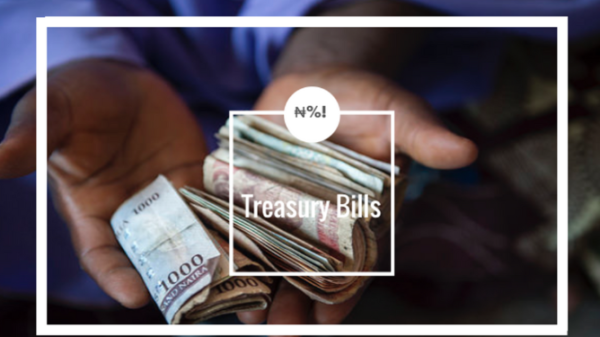
Nigerian Treasury Bills are short-term negotiable securities issued by the Central Bank of Nigeria (CBN) on behalf of the Federal Government. They are a key monetary policy tool used to manage liquidity and influence interest rates in the economy. When NTBs are sold, cash is withdrawn from the financial system, helping to curb excess liquidity that could fuel inflation or weaken the naira. At maturity, funds are returned to investors with interest, injecting liquidity back into the system.
By adjusting the frequency of auctions and the stop rates at which bills are issued, the CBN and the DMO jointly influence money supply conditions, inflation dynamics, and overall financial system stability.
Implications for the fixed-income market
The N1.144 trillion raised at the first NTB auction of 2026 underscores the Federal Government’s continued reliance on the domestic debt market to meet its funding needs. It also highlights the depth of investor demand for government securities, even in a high-rate environment.
For the broader fixed-income market, the across-the-board rise in stop rates suggests that tight monetary conditions are likely to persist in the near term. Investors, particularly institutional players, are expected to continue favoring longer-dated NTBs as a means of locking in attractive returns, while shorter tenors may increasingly serve as tools for liquidity management rather than primary yield drivers.
Overall, the auction sets the tone for the year, pointing to elevated yields, strong liquidity, and a market that remains highly responsive to inflation expectations and monetary policy signals.

Emmanuel Bassey is a Financial Expert that has worked in the Banking and Finance Industry for over 15+ years across different banks in Nigeria


