

























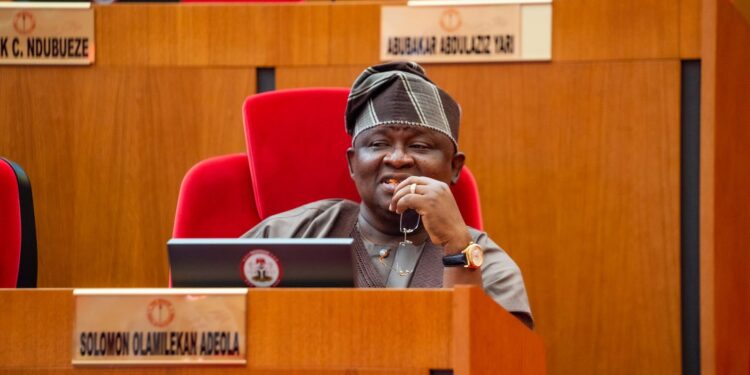
Nigeria is saving more than ₦10 trillion annually following the removal of fuel subsidies, a move Senator Solomon Adeola has described as one of the most consequential economic reforms undertaken by the administration of President Bola Ahmed Tinubu.
The chairman of the Senate Committee on Appropriation made the disclosure over the weekend in Ogun State, where he defended the controversial policy and argued that it has significantly eased the country’s fiscal burden after decades of what he called wasteful public spending.
According to Senator Solomon Adeola, the fuel subsidy regime had for years acted as a major drain on Nigeria’s finances, benefiting only a narrow segment of the population while forcing the government to borrow heavily to keep petrol prices artificially low. He said the decision by President Tinubu to discontinue the subsidy marked a turning point in the nation’s economic management.
“I am a living testimony to what the president has done within his first two years in office,” Adeola said. “He removed a cankerworm that has eaten deep into our economy for decades. The fuel subsidy benefited very few Nigerians, but its cost was borne by the entire country.”
Drawing from his experience as a former chairman of the Senate Committee on Finance, Adeola said Nigeria routinely borrowed between ₦6 trillion and ₦7 trillion every year just to finance fuel subsidies. When combined with other associated costs and inefficiencies, he noted, the total annual burden on public finances exceeded ₦10 trillion.
“With that singular action, the president is saving this country over ₦10 trillion on a yearly basis,” the senator stated, adding that the savings have created fiscal space for investment in critical infrastructure and other development priorities.
Adeola also praised the Tinubu administration for what he described as an aggressive push to rebuild Nigeria’s infrastructure base, arguing that the long-term benefits would outweigh the short-term pain Nigerians are experiencing as a result of higher fuel prices. He said the president remains committed to building a secure and prosperous country despite economic headwinds and widespread public criticism.
Context and background
Nigeria officially ended fuel subsidies in May 2023, shortly after President Tinubu was sworn into office. The announcement, made during his inaugural address, brought an abrupt end to decades of government intervention in petrol pricing. The policy was designed to reduce budget deficits, eliminate leakages and corruption associated with subsidy payments, and redirect scarce resources toward infrastructure, education, healthcare, and social programmes.
However, the removal of subsidies triggered a sharp increase in petrol prices nationwide, leading to higher transportation costs, rising food prices, and increased inflation. Labour unions, civil society organisations, and opposition figures criticised the move, arguing that it worsened the cost-of-living crisis for ordinary Nigerians.
Despite these concerns, Adeola maintained that the reform was unavoidable and long overdue. He argued that the previous system was unsustainable and had left the country vulnerable to debt accumulation and fiscal instability.
Infrastructure as reinvestment strategy
The senator said the federal government is channeling subsidy savings into large-scale infrastructure projects designed to stimulate economic growth and create jobs. He cited the Lagos-Calabar Coastal Highway as a flagship project that will traverse multiple states and unlock economic activity along Nigeria’s southern corridor.
He also highlighted the Sokoto-Badagry Super Highway, describing it as a transformational project that would reshape connectivity across the country. According to Adeola, the highway is expected to include up to 66 dams upon completion, supporting irrigation, power generation, and regional development.
“The Lagos–Calabar road alone will cut across about 10 to 15 states. That is a new Nigeria being built,” he said. “Along the Sokoto–Badagry corridor, we are talking about dozens of dams that will drive agriculture and development.”
What you should know
In 2024, the presidency disclosed that Nigeria is saving about $7.5 billion annually from funds previously allocated to fuel subsidies. The disclosure was made by Sunday Dare, Special Adviser on Media and Public Communications to President Tinubu.
Meanwhile, projections by the Federal Ministry of Finance under the Accelerated Stabilisation and Advancement Plan (ASAP), presented by Wale Edun, showed that fuel subsidy spending could have reached ₦5.4 trillion in 2024, compared with ₦3.6 trillion budgeted in 2023, had the policy not been scrapped.
Overall, Adeola’s remarks reinforce the government’s argument that subsidy removal, while painful in the short term, is central to restoring fiscal discipline and laying the foundation for sustainable economic growth in Nigeria.

Emmanuel Bassey is a Financial Expert that has worked in the Banking and Finance Industry for over 15+ years across different banks in Nigeria


