




















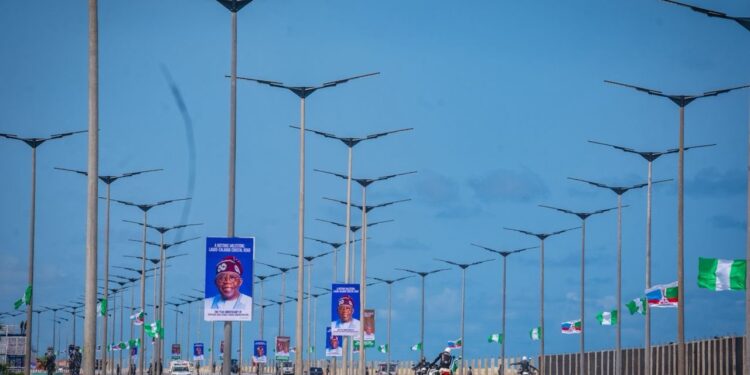
Nigeria has secured fresh momentum for one of its most ambitious infrastructure projects as the Federal Government announced the successful arrangement of approximately $1.2 billion in financing backed by the United Arab Emirates for the Lagos–Calabar Coastal Highway. The development underscores growing international confidence in Nigeria’s infrastructure drive and provides renewed assurance that construction on the landmark coastal road will continue without disruption.
The announcement was made in a statement from the Presidency on Friday and reported by Bloomberg. According to the disclosure, the newly secured funding will be deployed to support construction work on a 56-kilometre stretch of the highway, a critical segment of the broader project that is expected to redefine transport and logistics along Nigeria’s Atlantic coastline.
When fully completed, the Lagos–Calabar Coastal Highway is projected to run for about 700 kilometres, cutting across several coastal states and linking major commercial, industrial, and tourism hubs in southern Nigeria. The road is envisioned as a high-capacity transport corridor that will ease congestion, reduce travel times, and open up new economic opportunities for coastal communities.
Federal Government’s position
President Bola Tinubu described the financing agreement as a major milestone that guarantees continuity on the project at a time when Nigeria is aggressively seeking to close its infrastructure deficit.
“This is a major achievement, and closing this transaction means the Lagos–Calabar Coastal Highway will continue unimpeded,” the President said in the statement. He added that the administration remains committed to deploying innovative and diversified financing structures to deliver large-scale infrastructure across the country, without placing excessive strain on public finances.
The President’s remarks align with the Tinubu administration’s broader strategy of leveraging foreign capital, multilateral institutions, and private-sector partnerships to accelerate economic development and modernise Nigeria’s transport network.
Context and financing structure
The latest $1.2 billion facility builds on earlier funding secured for the same project, highlighting its scale and phased execution model. In July, Nigeria had arranged an additional $747 million in financing for another section of the coastal highway, signalling steady progress in mobilising capital for different segments of the road.
That earlier transaction was led by Deutsche Bank, which acted as Global Coordinator and Lead Arranger. The loan syndicate included a mix of international and regional financial institutions, such as First Abu Dhabi Bank, African Export-Import Bank, ECOWAS Bank for Investment and Development, Nexent Bank N.V. (formerly Credit Europe Bank N.V.), and Zenith Bank Plc.
Notably, the facility was fully underwritten by First Abu Dhabi Bank, with risk cover provided by the Islamic Corporation for the Insurance of Investment and Export Credit. This structure reflects increasing Gulf participation in Nigeria’s infrastructure financing landscape, as Middle Eastern lenders and insurers deepen their exposure to African growth projects.
Construction progress and technical standards
Construction of the highway is being handled by Hitech Construction, whose Managing Director, Dany Abboud, recently confirmed that more than 70% of the funded section has already been completed. He also highlighted the use of Continuously Reinforced Concrete Pavement (CRCP) technology, noting that it offers superior durability, lower lifecycle costs, and reduced maintenance compared to conventional asphalt roads.
According to Abboud, adopting CRCP sets a new benchmark for road construction in Nigeria and is expected to deliver long-term value for money, especially for a high-traffic coastal corridor exposed to harsh weather conditions.
Why it matters
The latest UAE-backed financing significantly strengthens funding certainty for one of Nigeria’s largest road projects and sends a positive signal to global investors about the country’s infrastructure programme. Beyond construction, the Lagos–Calabar Coastal Highway is expected to have far-reaching economic impacts—boosting trade logistics, stimulating tourism, supporting coastal real estate development, and enhancing regional integration among southern states.
For the Tinubu administration, the project also represents a flagship symbol of its commitment to growth-enabling infrastructure. If delivered on schedule and to specification, the highway could become a critical artery for Nigeria’s blue economy ambitions and a cornerstone of long-term economic transformation along the Atlantic corridor.

Emmanuel Bassey is a Financial Expert that has worked in the Banking and Finance Industry for over 15+ years across different banks in Nigeria


