
































A coalition of U.S. unions, universities, and business groups has filed a federal lawsuit challenging President Donald Trump’s recent executive order imposing a $100,000 fee on new H-1B visas for highly skilled foreign workers.
The legal action, filed in San Francisco federal court on Friday, marks the first major challenge to the controversial measure, which critics say unlawfully alters a congressionally established immigration program and threatens innovation in key U.S. industries.
Lawsuit Targets Trump’s Immigration Fee Order
The lawsuit, brought by the United Auto Workers (UAW), the American Association of University Professors (AAUP), a nurse recruitment agency, and several religious organizations, argues that the new rule exceeds presidential authority and effectively transforms the H-1B program into a “pay-to-play” system.
They contend that the Immigration and Nationality Act, which governs the H-1B program, does not give the president the power to impose new fees or taxes, a responsibility reserved for Congress.
“The Proclamation transforms the H-1B program into one where employers must either ‘pay to play’ or seek a ‘national interest’ exemption,” the lawsuit states, warning that the policy invites selective enforcement and potential corruption.
Trump’s $100,000 Visa Fee Explained
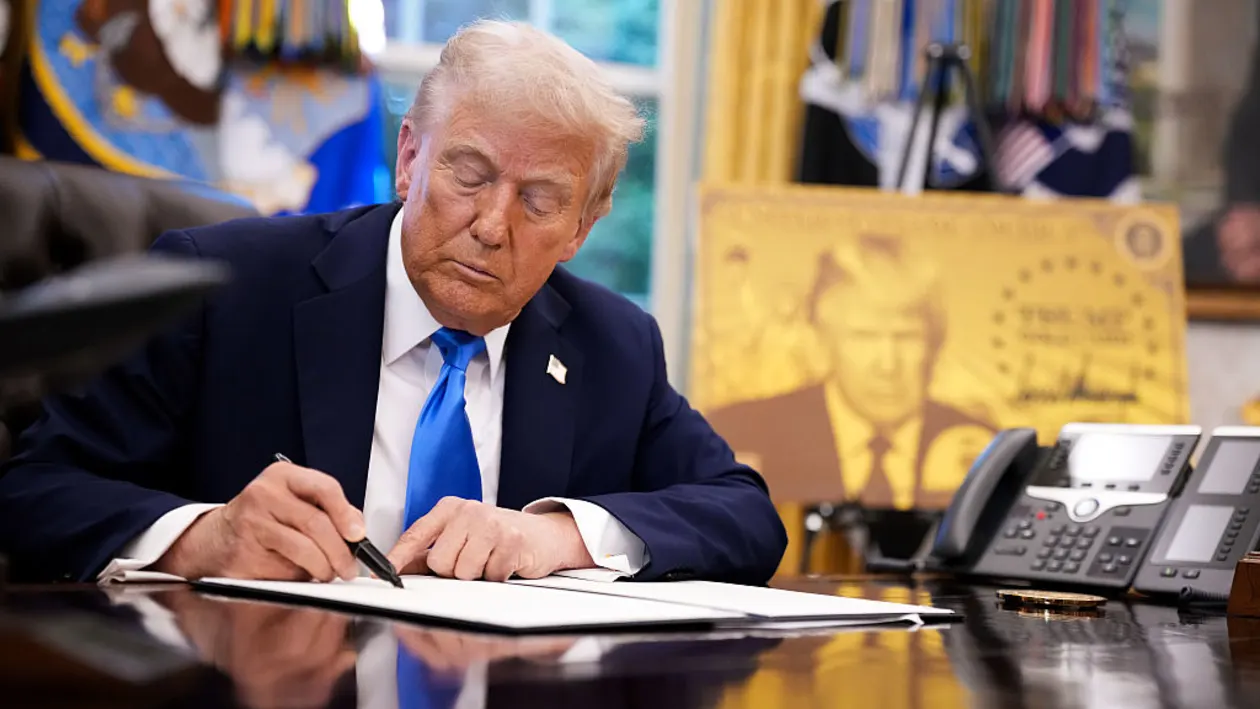
The executive order, signed on September 19, 2025, requires U.S. employers sponsoring new H-1B visa holders to pay an additional $100,000 before the foreign worker can enter the country. The policy does not apply to existing visa holders or applications filed before September 21.
Under current rules, H-1B sponsoring companies typically pay between $2,000 and $5,000 in processing and compliance fees, depending on their size and number of foreign hires.
The administration defended the steep new fee as part of a broader effort to discourage “system abuse” and to ensure that only firms with genuine skill shortages use the visa program.
White House spokeswoman Abigail Jackson said the policy aims to “discourage companies from spamming the system and driving down American wages, while providing certainty to employers who need to bring the best talent from overseas.”
A Longstanding Debate Over Skilled Immigration
The H-1B visa allows U.S. employers to hire foreign professionals in specialized fields, such as technology, engineering, medicine, and academia. The program currently allocates 65,000 visas annually, plus an additional 20,000 for applicants with advanced U.S. degrees.
Tech giants and universities have long relied on H-1B workers to fill skill gaps, particularly in science and engineering disciplines. However, critics — including labor advocates and some policymakers — argue that the system enables outsourcing firms to replace American workers with lower-paid foreign labor.
President Trump has repeatedly claimed that the program undermines U.S. workers and national security. In his latest proclamation, he cited “the large-scale replacement of American workers” and said the influx of lower-wage visa holders “discourages Americans from pursuing careers in science and technology.”
Legal Experts Question Presidential Authority
Legal analysts say the case could become a major test of the limits of executive power over immigration policy.
The plaintiffs argue that Trump’s order violates the U.S. Constitution’s separation of powers, asserting that the president cannot unilaterally impose financial obligations that effectively act as taxes or revenue measures.
They also claim that the Department of Homeland Security and State Department implemented new visa rules without proper regulatory procedures or consideration of the economic impact.
By bypassing formal rulemaking, the lawsuit says, the administration ignored the potential for “stifling innovation” in sectors that depend heavily on global talent.
Implications for U.S. Businesses and Global Talent
The new $100,000 fee could sharply curtail participation in the H-1B program, particularly among smaller firms and startups that depend on specialized international labor but lack the capital of large corporations.
Business coalitions have warned that the measure will make it harder for U.S. employers to remain competitive globally, especially in fields like artificial intelligence, software engineering, and healthcare, where skilled labor shortages persist.
According to government data, India accounts for about 71% of H-1B visa recipients each year, with China following at around 12%. The policy, therefore, could disproportionately affect Indian tech professionals and U.S. companies with large Indian workforces.
Broader Immigration Strategy
Trump’s executive order on H-1B visas was announced alongside the rollout of a new “Trump Gold Card,” which grants permanent residency to foreign nationals who invest $1 million in the United States. The two measures are part of a broader effort to reshape U.S. immigration policy to favor wealthy investors over skilled workers.
As the case moves forward, the outcome will likely determine how far the executive branch can go in restructuring employment-based immigration without congressional approval — a question that could have lasting implications for the future of America’s high-skilled workforce.

Emmanuel Bassey is a Financial Expert that has worked in the Banking and Finance Industry for over 15+ years across different banks in Nigeria


