





























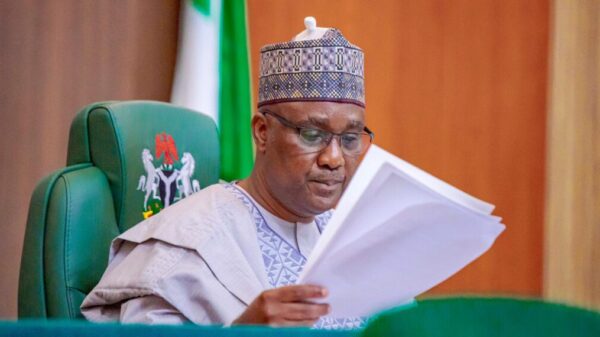


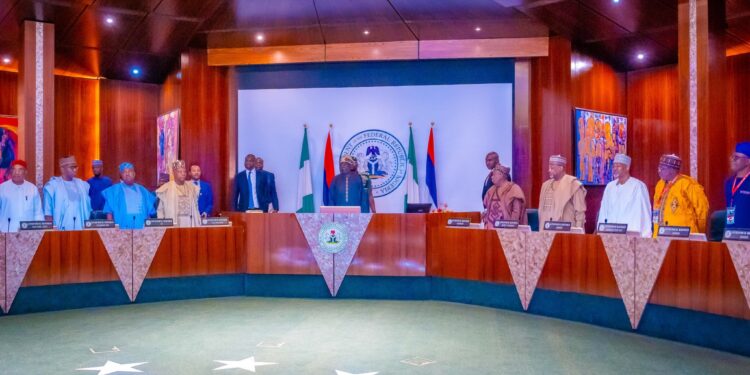
The Federal Executive Council (FEC) has approved a ₦58.47 trillion federal budget proposal for the 2026 fiscal year, marking another record-high spending plan as Nigeria grapples with rising development needs, mounting debt obligations, and a fragile macroeconomic environment.
The approval was granted on Friday during a special FEC meeting held in Abuja and was confirmed by Tanimu Yakubu, Director-General of the Budget Office of the Federation, during a post-meeting briefing.
According to Nairametrics, the approval comes just ahead of President Bola Ahmed Tinubu’s formal presentation of the 2026 Appropriation Bill to the National Assembly, setting the stage for legislative scrutiny of what is expected to be one of the most ambitious budgets in the country’s history.
Budget size and overall framework
Yakubu explained that the approved 2026 budget proposal is aligned with the 2026–2028 Medium-Term Expenditure Framework (MTEF) and Fiscal Strategy Paper, which had earlier been reviewed and endorsed by the Council as part of preparations for the new fiscal year.
He stated that the ₦58.47 trillion aggregate expenditure represents about a six percent increase over the 2025 budget estimate, reflecting the government’s intention to sustain spending on critical sectors while managing fiscal pressures.
Within the broader MTEF framework, Yakubu said the core federal budget size stands at ₦54.46 trillion, while retained revenue is projected at ₦34.33 trillion. The difference between projected revenue and planned expenditure implies a sizeable fiscal deficit, which is expected to be financed through a combination of domestic and external borrowing.
The aggregate spending figure also includes ₦4.98 trillion in projected expenditure by government-owned enterprises (GOEs) and ₦1.37 trillion earmarked for grants and donor-funded projects, highlighting the role of state-owned entities and development partners in overall public spending.
Key expenditure components
Breaking down the spending profile, Yakubu said statutory transfers are estimated at ₦4.1 trillion, while debt service obligations amount to ₦15.52 trillion. Included in the debt service figure is about ₦3.39 trillion allocated to the sinking fund, aimed at retiring maturing obligations owed to local contractors and creditors.
Personnel costs, including pensions, are projected at ₦10.75 trillion. This figure incorporates ₦1.02 trillion for government-owned enterprises and represents a seven percent increase compared with the 2025 provision. Overhead costs are estimated at ₦2.22 trillion, reflecting continued efforts to rein in administrative spending despite inflationary pressures.
Yakubu noted that the macroeconomic assumptions underpinning the budget were deliberately conservative and realistic, particularly with respect to oil prices, exchange rate expectations, and projected dividends from government-owned enterprises.
Although total revenue is projected to decline slightly compared with earlier expectations, non-oil revenue is expected to account for roughly two-thirds of total receipts, signalling a gradual shift away from Nigeria’s long-standing dependence on oil income.
Revenue assumptions and macroeconomic benchmarks
Earlier this month, the FEC approved the 2026–2028 MTEF, which sets the fiscal and macroeconomic parameters guiding the budget. The Minister of Budget and Economic Planning, Atiku Bagudu, disclosed that the Federal Government is projecting total revenue inflows of ₦34.33 trillion in 2026, including ₦4.98 trillion expected from government-owned enterprises.
Under the approved framework, oil production is benchmarked at 2.6 million barrels per day for 2026. The oil price benchmark was set at $64 per barrel, while the exchange rate assumption stands at ₦1,512 to the dollar.
These assumptions contrast with those used in the 2025 budget. In December 2024, President Tinubu said the 2025 budget assumed inflation would moderate sharply from 34.6 percent to 15 percent, while the exchange rate was expected to improve from around ₦1,700 per dollar to ₦1,500 per dollar.
In its latest outlook, Standard Bank projected that the naira would close at about ₦1,458.8 to the dollar by December 2025, lending some support to the exchange-rate assumptions used in the 2026 budget framework.
What happens next
With FEC approval secured, attention now shifts to the National Assembly, where lawmakers will debate the budget’s assumptions, spending priorities, and financing plan. Analysts expect discussions to focus heavily on debt sustainability, revenue realism, and the government’s ability to execute capital projects efficiently.
As Nigeria prepares to enter another high-spending fiscal year, the ₦58.47 trillion 2026 budget proposal underscores the balancing act facing policymakers: stimulating growth and development while containing deficits and rebuilding fiscal credibility in an increasingly constrained economic environment.

Emmanuel Bassey is a Financial Expert that has worked in the Banking and Finance Industry for over 15+ years across different banks in Nigeria


