































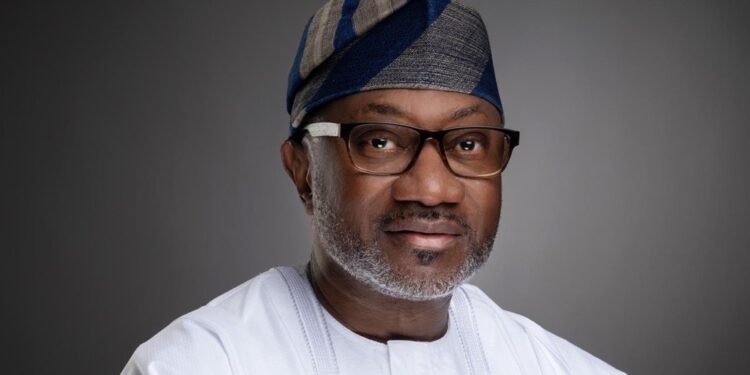
Billionaire investor and Chairman of First HoldCo Plc, Femi Otedola, has called on Nigerian regulators to raise the minimum capital requirement for banks with international licences to at least N1 trillion, arguing that stronger capital buffers are essential for building a resilient financial system capable of supporting a $1 trillion economy.
Otedola made the call while reacting to recent reforms in Nigeria’s financial and economic landscape, shortly after FirstBank, the commercial banking subsidiary of First HoldCo Plc, completed a N500 billion capital raise to meet the current minimum requirement set by the Central Bank of Nigeria (CBN) for international banking operations.
Reflecting on more than three decades of investing and business leadership, Otedola said he rarely comments publicly on policy matters, but stressed that Nigeria is at a defining moment where decisive leadership deserves recognition. He praised Bola Ahmed Tinubu for what he described as courage and clarity in implementing difficult but necessary economic reforms.
According to Otedola, President Tinubu’s policies are rooted in a deep understanding of Nigeria’s economic structure and have begun to lay the foundation for sustainable growth. He noted that while reforms often come with short-term pain, the long-term benefits are now becoming evident, both domestically and in the way global investors perceive Nigeria’s economy.
In the same vein, Otedola commended the performance of the CBN Governor, Yemi Cardoso, describing his leadership as exceptional. He attributed the recent slowdown in inflation to the CBN’s disciplined return to orthodox monetary policy, arguing that policy consistency, rather than ad-hoc interventions, is critical to restoring macroeconomic stability.
Otedola also highlighted reforms in the foreign exchange market, noting that the strengthening of the naira is increasingly being driven by market fundamentals rather than artificial controls. He said this shift has restored confidence that had been missing for years, adding that the rise in Nigeria’s external reserves to a seven-year high above $46 billion underscores the credibility of current monetary management.
Turning to the banking sector, Otedola said the ongoing recapitalisation exercise is one of the most important reforms undertaken in recent years. While the move initially attracted criticism, he argued that the strong profits recorded by banks in 2024 and the consolidation seen in 2025 have validated the policy. In his view, higher capital thresholds will enable banks to lend more effectively to the real sector, strengthen governance structures, and reduce the dominance of weakly capitalised institutions.
From this perspective, Otedola said the current N500 billion minimum capital requirement for international banking licences should be seen as a stepping stone rather than an endpoint. He called for an increase to at least N1 trillion, stressing that an economy aspiring to reach the $1 trillion mark cannot rely on undercapitalised banks. Stronger banks, he said, would mean broader ownership, better risk management, and institutions that are run as enduring enterprises rather than personal estates.
Within this context, FirstBank’s successful completion of its N500 billion capital raise represents a key milestone. The bank has now met the CBN’s existing capital requirement for international operations, reinforcing its position as one of Nigeria’s systemically important financial institutions. Otedola noted that shareholders of First HoldCo Plc remain committed to injecting additional capital, not only into FirstBank but also into other subsidiaries and new business adjacencies as growth opportunities emerge.
Concluding his remarks, Otedola described Yemi Cardoso as the best Central Bank Governor Nigeria has produced, citing his calm leadership style, discipline, and focus on long-term stability over short-term popularity. He expressed confidence that Nigeria is turning a corner and pledged continued support from long-term investors for monetary and financial sector reforms that are laying a stronger foundation for sustainable economic growth.
Overall, Otedola’s comments underscore growing support among leading business figures for deeper banking sector reforms, particularly higher capital requirements, as Nigeria seeks to build a more robust financial system capable of supporting long-term development ambitions.

Emmanuel Bassey is a Financial Expert that has worked in the Banking and Finance Industry for over 15+ years across different banks in Nigeria


