

































President Bola Ahmed Tinubu has announced that Nigeria will fully transition to a single annual budget cycle starting from April 2026, marking a major shift in the country’s public finance framework aimed at improving planning discipline, budget execution, and fiscal transparency.
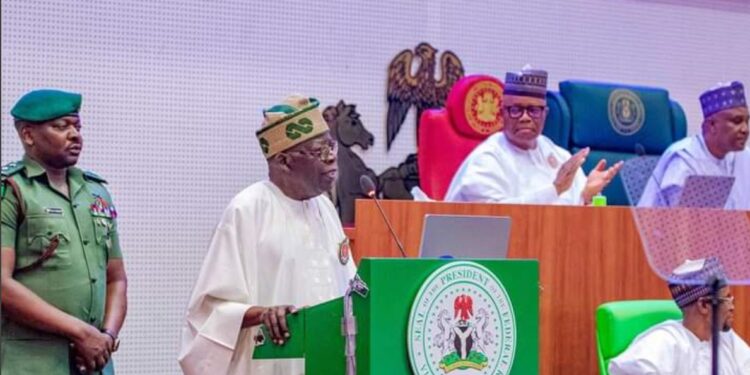
The declaration was made on Friday during the presentation of the 2026 Appropriation Bill to a joint session of the National Assembly, where the president outlined what he described as a decisive break from years of overlapping budgets that have complicated fiscal management and weakened accountability across government institutions.
Ending the era of overlapping budgets
Tinubu said the practice of running multiple budgets concurrently—often involving a main budget, supplementary appropriations, and rolled-over capital projects—has distorted planning, delayed capital releases, and undermined transparency across Ministries, Departments and Agencies (MDAs).
“We are terminating the habit of running three budgets in one inflow,” the president said. “By March 31, 2026, all capital liabilities from previous years will be fully funded and closed. From April, Nigeria operates on a single budget, backed by a single revenue cycle. No overlaps, no excuses, no rollovers culture.”
According to the president, the move is part of a broader fiscal reform agenda designed to reset Nigeria’s budget calendar and restore order to public financial management. He explained that the decision to extend the current budget cycle to March 31, 2026, is intended to provide sufficient time to clear outstanding capital obligations inherited from previous fiscal years.
Once these liabilities are settled, Tinubu said Nigeria would be better positioned to return to a cleaner, more predictable single-cycle budgeting framework, where each fiscal year’s revenues and expenditures are clearly defined and fully accounted for within the same period.
Why the reform matters
Analysts have long criticised Nigeria’s budgeting process for its frequent extensions and rollovers, which often result in capital projects being funded across multiple fiscal years without clear timelines or accountability benchmarks. The overlapping approach has also made it difficult for lawmakers and the public to assess budget performance accurately.
By committing to a single annual budget cycle, the administration aims to improve capital project delivery, strengthen oversight, and enhance transparency in how public funds are allocated and spent. Tinubu said the reform builds on ongoing measures such as budget revisions, adjustments to capital targets, and intensified revenue mobilisation efforts.
Background to the decision
The announcement follows a series of legislative and executive actions aimed at realigning Nigeria’s fiscal calendar. Earlier, President Tinubu formally requested the House of Representatives to repeal and re-enact the 2024 and 2025 budgets, alongside a proposal to extend the 2025 budget’s implementation period to March 31, 2026.
In his letter to lawmakers, the president explained that the request sought to repeal the 2024 Appropriation Act of ₦35.06 trillion and re-enact it with a revised total expenditure of ₦43.56 trillion. Under the revised 2024 budget, ₦1.74 trillion was allocated for statutory transfers, ₦8.27 trillion for debt service, ₦11.27 trillion for recurrent expenditure, and ₦22.28 trillion for capital projects, with implementation extended to December 31, 2025.
Tinubu also proposed cutting the 2025 budget from ₦54.99 trillion to ₦48.32 trillion, while extending its lifespan to March 31, 2026. These adjustments were presented as necessary steps to reconcile accumulated obligations and restore coherence to the budgeting process.
In June, the Senate approved a second extension of the implementation period for the 2024 capital component of the national budget, pushing the deadline from June 30, 2025, to December 31, 2025. Earlier, on December 18, 2024, the National Assembly had approved extending the 2024 budget’s lifespan to June 2025.
A shift from recent practice
The January-to-December budget implementation cycle, widely regarded as a hallmark of fiscal discipline, was firmly established during the tenure of the 9th National Assembly. However, repeated extensions over the past two years have gradually eroded that framework, leading to the overlapping cycles Tinubu is now seeking to eliminate.
Last week, the Federal Government further underscored the scale of the challenge by directing MDAs to carry over 70 percent of their approved 2025 capital allocations into the 2026 budget. While officials argued that the directive would reduce waste and duplication, critics said it highlighted how deeply entrenched the rollover culture had become.
Looking ahead
With the declaration of a single budget cycle from April 2026, attention now turns to implementation. Analysts say the success of the reform will depend on strict adherence to timelines, realistic revenue projections, and disciplined capital releases.
If fully executed, the shift could mark a turning point in Nigeria’s fiscal management, improving budget credibility, strengthening oversight, and restoring confidence among investors, development partners, and citizens alike.

Emmanuel Bassey is a Financial Expert that has worked in the Banking and Finance Industry for over 15+ years across different banks in Nigeria


