





























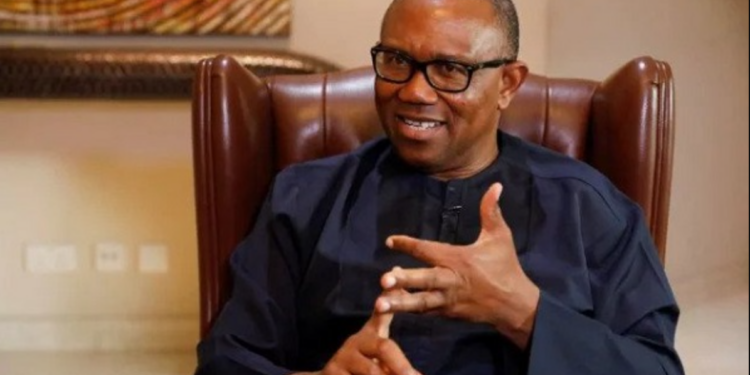
Former presidential candidate and former Anambra State Governor, Peter Obi, has sharply criticised the Federal Government for failing to pay contractors who executed federally approved projects, even as the government continues to tout impressive revenue gains for 2025. Obi made the remarks in a detailed statement posted on X (formerly Twitter), responding to fresh protests by contractors across Abuja and several other parts of the country.
The protests, which have intensified in recent weeks, stem from months of mounting frustration among local contractors whose payments for verified and completed projects in 2024 and 2025 remain outstanding. Many of these contractors claim that they fulfilled all contractual obligations, only to be stalled by federal bureaucracies despite repeated assurances of forthcoming payments. As the demonstrations continue, Obi has positioned the issue as both an economic and governance failure.
Obi’s Concerns and Criticisms
In his statement, Obi described the plight of local contractors—especially small and medium-sized enterprises (SMEs)—as alarming and unacceptable. He emphasised that many of the contractors currently protesting represent everyday Nigerians who rely on government contracts to survive, retain employees, and keep local economies functioning.
He noted that several images and reports circulating online show contractors demonstrating at key federal institutions, demanding payment for work that has already been certified as completed. According to Obi, the unfolding events underscore a pattern of disregard for the economic wellbeing of SMEs, which he described as “the backbone of regional development.”
“Most of these contractors are small and medium-sized businesses that are essential to the economy in various regions, comprising ordinary Nigerians who have delivered vital public services with the expectation that the government would honour its commitments,” Obi said.
He further expressed concern that the protests were occurring in the same period that the government has repeatedly announced strong revenue performance. He recalled President Bola Tinubu’s public declaration in August that Nigeria had “met and surpassed its revenue target for the year,” a claim widely circulated by government officials and state media.
According to Obi, such declarations create a contradiction when the same government fails to meet basic financial obligations. He argued that the disparity raises deeper questions about transparency, prudence, and accountability in Nigeria’s public finance management.
“A responsible government cannot claim record revenue while simultaneously leaving thousands of contractors unpaid. This contradiction highlights deeper issues related to transparency in our public finance management and governance,” he added.
Broader Economic Impact
Beyond the governance concerns, Obi warned that the non-payment of contractors carries long-term economic risks. Many affected businesses, he noted, are already struggling with rising operational costs, inflationary pressures, and reduced access to credit. Delayed payments could force contractors to lay off workers, suspend operations, or shut down entirely—outcomes that could directly reduce Nigeria’s productive capacity.
He stressed that unpaid obligations ripple across families and communities: workers lose salaries, small suppliers lose revenue, and regional economies slow down. According to him, no government that neglects local businesses can build a strong and sustainable economy.
He called on the Federal Government to convert its improved revenue performance into concrete economic support by promptly settling outstanding contractor payments and strengthening the micro, small, and medium-sized enterprise (MSME) ecosystem. Honour, credibility, and trust in governance, he said, rest heavily on fulfilling financial commitments.
Context and Background
Contractors—particularly members of the All Indigenous Contractors Association of Nigeria (AICAN)—have been protesting intermittently for months. Demonstrations have taken place at the Federal Ministry of Finance, the National Assembly, and other strategic locations. AICAN earlier threatened a nationwide protest beginning November 3 over what it described as “long-overdue payments” for projects, some of which had even been commissioned without settling contractors.
In June, the Federal Government announced plans to clear verified outstanding payments. The Office of the Accountant General confirmed ongoing efforts to reconcile and settle approved obligations. The Nigerian Senate also approved a second extension of the 2024 capital budget implementation deadline, shifting it from June 30, 2025, to December 31, 2025—an extension meant to allow for proper funding and execution of capital projects.
Despite these steps, many contractors say payments remain elusive, fueling public criticism and reinforcing Obi’s position that Nigeria’s fiscal management still suffers from systemic gaps.

Emmanuel Bassey is a Financial Expert that has worked in the Banking and Finance Industry for over 15+ years across different banks in Nigeria


