































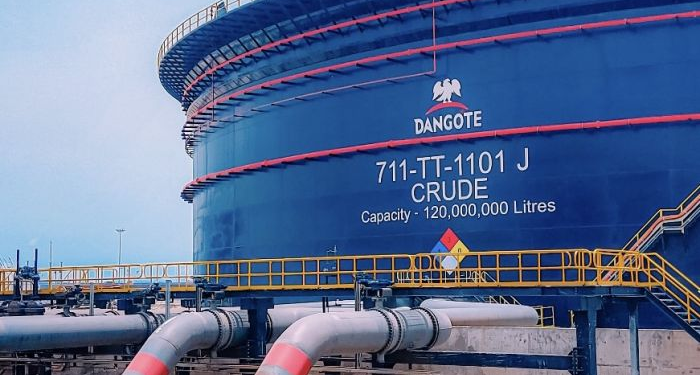
Dangote Petroleum Refinery has announced its readiness to fully meet Nigeria’s domestic petrol demand, pledging to supply 1.5 billion litres of Premium Motor Spirit (PMS) monthly—equivalent to 50 million litres per day—beginning December 2025. This output is scheduled to further increase to 1.7 billion litres per month, or 57 million litres per day, starting in February 2026 as refining operations expand.
The refinery formalised this commitment in a letter addressed to the Nigerian Midstream and Downstream Petroleum Regulatory Authority (NMDPRA). Dated November 30, 2025, and signed by the company’s Chief Executive Officer, David Bird, the correspondence requested regulatory cooperation to ensure seamless operations, transparent reporting, and uninterrupted product distribution nationwide.
Call for Onsite Verification and Full Transparency
As part of its plan to build public trust and assure market stability, Dangote Refinery invited NMDPRA officials to be physically present at the refinery from December 1, 2025. Their role would be to verify and publicly publish the refinery’s daily production figures, stock levels, and product availability.
In the letter, Bird emphasised that real-time transparency is critical to boosting public confidence, especially at a time when Nigerians remain concerned about irregular supply patterns, import dependency, and rising fuel prices. Publishing daily output data—across online platforms and print media—would, according to the refinery, help dispel doubts about domestic capacity and demonstrate the refinery’s consistency in meeting national demand.
Operational Challenges and the “Nigeria First” Supply Policy
The refinery also appealed to NMDPRA to ensure the smooth importation of crude oil, feedstock, and blending components necessary for its operations. According to the letter, Dangote Refinery continues to face delays in vessel clearance, which disrupt refining schedules, inflate operational costs, and ultimately affect consumers at the pump.
Bird described these delays as avoidable inefficiencies, noting that eliminating them would strengthen Nigeria’s fuel security and support the federal government’s “Nigeria First” policy—a strategy prioritising domestic refining over import-driven supply chains.
“The Dangote refinery is ready and able to supply Nigeria’s PMS needs,” Bird stated. “We will appreciate your support to secure Nigeria’s domestic fuel security and abundance. Please allow the ‘Nigeria First’ policy to work to the benefit of all Nigerians.”
A Potential Turning Point for Nigeria’s Downstream Sector
The refinery’s pledge comes at a critical time for Nigeria’s downstream sector, which for years has struggled with unpredictable supplies and chronic dependence on imported petrol. Despite modest contributions from smaller local refineries, imports remain the backbone of domestic PMS availability.
Dangote Refinery—Africa’s largest single-train refinery—has long been positioned as a transformative project for Nigeria’s energy ecosystem, with the potential to reverse decades of fuel import dependence. The commitment to supply more than 50 million litres daily represents a major step toward that goal.
The refinery’s willingness to open its operations to regulatory scrutiny further signals confidence in its production capacity and a bid to establish itself as the dominant supplier of PMS within the country.
Regulatory Insights and National Consumption Trends
The NMDPRA recently reported that Nigeria consumed an average of 56.74 million litres of petrol daily in October 2025. Of this amount, 27.6 million litres were supplied through imports, while 17.08 million litres came from domestic refining operations.
Although the gap remains significant, the regulatory authority noted that the share of locally sourced PMS has been rising gradually. Dangote Refinery’s new production plan—if executed consistently—could not only close the supply deficit but potentially allow Nigeria to eliminate PMS imports altogether.
Implications for Fuel Security and Economic Stability
If successful, Dangote’s monthly supply of 1.5–1.7 billion litres marks a major milestone in Nigeria’s quest for energy self-sufficiency. Reduced reliance on imports could stabilise pump prices, improve foreign exchange savings, and ease pressure on the naira—long strained by high dollar demand from fuel importers.
Moreover, the refinery’s operational scale provides an opportunity for the government to reposition Nigeria as a regional petroleum hub capable of exporting surplus products across West and Central Africa.
As the December rollout approaches, stakeholders will be watching closely to assess whether Dangote Refinery’s output and distribution can match its ambitious commitments—and whether regulatory collaboration will ensure the “Nigeria First” policy delivers on its promise of fuel security, affordability, and transparency.

Emmanuel Bassey is a Financial Expert that has worked in the Banking and Finance Industry for over 15+ years across different banks in Nigeria


