

































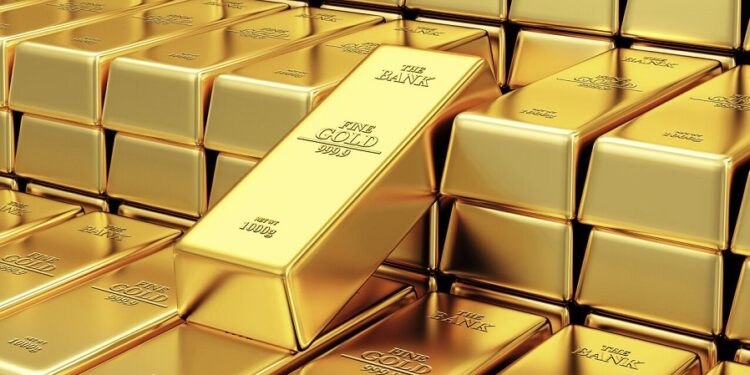
Global commodity markets witnessed a historic moment on Wednesday as gold surged past the $4,500-per-ounce threshold for the first time ever, underscoring a powerful rally across precious metals. The milestone reflects a potent mix of geopolitical anxiety, shifting monetary policy expectations, and sustained investor demand for safe-haven assets.
Spot gold climbed nearly 1% in early trading to hit an intraday record above $4,525 an ounce before paring gains to trade little changed later in the session. The advance marked a third consecutive day of gains and capped one of the strongest bull runs in the metal’s modern trading history. Analysts say the move above $4,500 is as much psychological as it is fundamental, reinforcing gold’s role as a hedge against uncertainty.
The rally was fueled by escalating geopolitical tensions in Venezuela, following fresh U.S. sanctions targeting oil tankers linked to the country’s exports, as well as mounting expectations that the Federal Reserve will begin cutting interest rates in 2026. Lower borrowing costs typically reduce the opportunity cost of holding non-yielding assets like gold, making the metal more attractive to investors.
Best annual performance in decades
Gold is now up nearly 70% year-to-date, putting it on course for its strongest annual performance since 1979. Silver has delivered an even more dramatic rally, soaring almost 150% in 2025, while platinum has also recorded triple-digit gains. Market participants point to a rare convergence of macroeconomic, geopolitical, and structural factors driving the surge.
A key pillar of support has been aggressive central bank buying and steady inflows into exchange-traded funds. According to the World Gold Council, holdings in gold-backed ETFs have increased in every month of 2025 except May, highlighting consistent institutional demand. State Street’s SPDR Gold Trust, the world’s largest gold ETF, has expanded its holdings by more than 20% this year alone.
Gold’s resilience has also impressed traders. After retreating briefly from an October peak of $4,381 an ounce, prices rebounded swiftly, signaling strong underlying demand. Investment bank Goldman Sachs has forecast that gold could climb as high as $4,900 an ounce in 2026, with analysts warning that risks remain skewed to the upside should geopolitical tensions worsen or monetary easing accelerate.
Silver’s spectacular surge
Silver has outshone gold in percentage terms, breaking through $70 an ounce earlier in the week and climbing as high as $72.70, a new all-time high. The metal’s rally has been turbocharged by speculative inflows, lingering supply disruptions, and the aftershocks of a historic short squeeze in October.
Despite significant inflows of silver into London vaults, much of the world’s available supply remains concentrated in New York. Traders are closely watching a U.S. Commerce Department investigation into critical mineral imports, which could result in tariffs or restrictions and further tighten supply. These uncertainties have added fresh momentum to silver’s already explosive run.
Platinum joins the record-breaking spree
Platinum also extended its winning streak, jumping as much as 4% to surpass $2,300 an ounce for the first time since data tracking began in 1987. The metal has now risen for 10 consecutive sessions, its longest rally since 2017, and is up roughly 150% for the year—its largest annual increase on record.
Widely used in automotive catalytic converters and jewelry, platinum has benefited from tight global supplies and production disruptions in South Africa, one of the world’s largest producers. Analysts warn that the platinum market is heading for a third consecutive annual deficit, a dynamic that could keep prices elevated well into 2026.
Signs of overheating, but momentum intact
Technical indicators suggest the market may be entering overbought territory. Gold’s 14-day relative strength index (RSI) climbed to around 81, while silver’s RSI hovered near 82—well above the 70 threshold typically associated with stretched valuations. Still, many analysts argue that strong fundamentals and persistent uncertainty justify higher prices in the near term.
By midday in London, spot gold was trading around $4,495 an ounce, silver hovered above $72, and platinum held firm above $2,300. Palladium, however, gave up earlier gains, lagging behind its precious-metal peers.
What you should know
Earlier in December, the World Gold Council projected that gold could rise a further 15–30% in 2026, extending its multi-year bull run. In 2025 alone, gold recorded more than 50 all-time highs and delivered returns exceeding 60%, driven by geopolitical instability, a weakening U.S. dollar, and strong momentum trading.
The report noted that institutional and retail investors, alongside central banks, significantly increased their exposure to gold as they sought diversification, inflation protection, and long-term stability. With global uncertainty showing little sign of easing, precious metals appear poised to remain at the center of investor attention heading into the new year.

Emmanuel Bassey is a Financial Expert that has worked in the Banking and Finance Industry for over 15+ years across different banks in Nigeria


