




Creator
  • Type:
  • Genre:
  • Duration:
  • Average Rating:
Log In
 
  • Marketplace
Log In
 
  • Type:
  • Genre:
  • Duration:
  • Average Rating:
  • Marketplace

Budget

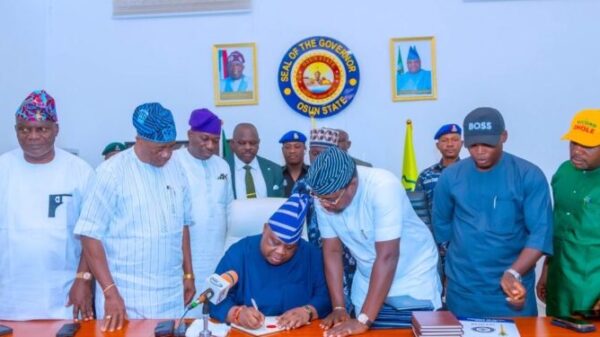
Adeleke Signs N723bn Osun 2026 Budget Into Law, Signals Final Push of First-Term Agenda

  • dollaers
  • December 30, 2025
  • Budget
  • 0 comments

The Governor of Osun State, Ademola Adeleke, has signed the state’s N723 billion 2026 Appropriation Bill into law, formally approving what will be the final budget of his first term in office. The signing marks a critical moment for the administration, as it seeks to consolidate three years of fiscal and governance reforms while laying the groundwork for future development initiatives.

The budget signing ceremony took place on Monday in Osogbo, the state capital, with key members of the executive arm of government in attendance. Among those present were the Deputy Governor, Kola Adewusi, and members of the Osun State Executive Council. The development was confirmed in an official statement issued by the governor’s spokesperson, Malam Olawale Rasheed.

Governor Adeleke described the 2026 budget as a strategic instrument designed to deepen governance reforms, expand service delivery, and sustain development outcomes across the state. According to him, the fiscal plan aligns with his administration’s five-point development agenda, which focuses on infrastructure renewal, social welfare, economic revitalisation, good governance, and improved service delivery to citizens.

The governor explained that the N723 billion budget would be deployed both to complete ongoing projects inherited or initiated during his tenure and to roll out new initiatives aimed at improving the quality of life for residents. He stressed that continuity and consolidation remain key priorities, particularly in sectors where progress has already been recorded.

“Our administration has, in the last three budget years, laid a solid foundation for the sustainable development of our dear state,” Adeleke said. “We completed many abandoned projects and launched new ones. We paid billions of naira in pension and salary debts. We prioritised workers’ welfare, approved and implemented payments of promotion arrears, and cleared allowances that were neglected by the previous administration.”

He added that the outcomes of previous budgets under his leadership have been encouraging, noting that tangible improvements have been recorded in infrastructure delivery, social services, and fiscal management. Adeleke maintained that the 2026 budget is structured to build on these gains while addressing emerging needs across the state.

Beyond infrastructure and welfare spending, the signing of the budget also reflects the administration’s broader effort to strengthen Osun State’s fiscal position. In July, the state government announced that it had achieved a significant reduction in its debt profile, revealing that Osun’s debt burden had been cut by 43 percent between 2022 and 2025. The government attributed the reduction to improved revenue management, debt restructuring, and disciplined spending.

Originally presented to the Osun State House of Assembly on November 12 at N705 billion, the 2026 budget was later reviewed and adjusted upward to N723 billion. The revised figure was passed by lawmakers on December 23, following deliberations and amendments during the legislative review process. The adjustments reflect additional funding needs identified by lawmakers in collaboration with the executive arm.

The approval of the budget sends a clear signal that the Osun State government intends to consolidate past achievements while positioning the state for sustained growth beyond the current administration’s first term. Analysts note that the final-year budget of any administration often serves as a benchmark for assessing policy direction, fiscal discipline, and governance priorities.

According to the latest data from the Debt Management Office for the first quarter of 2025, Osun State’s total debt stock stood at N83.3 billion. The same data showed that the combined debt of the 36 states and the Federal Capital Territory amounted to N3.87 trillion. At the national level, Nigeria’s total public debt rose to N149.39 trillion as of March 31, 2025, representing a year-on-year increase of N27.72 trillion, or 22.8 percent, compared to N121.67 trillion recorded in the corresponding period of 2024.

In a further demonstration of its commitment to social welfare, the Adeleke administration earlier approved a N4 billion bond in May for the payment of retirees under the contributory pension scheme. The move was widely welcomed by labour groups and pensioners, many of whom had faced prolonged delays in accessing their entitlements.

With the signing of the N723 billion 2026 budget, Governor Adeleke’s administration enters a decisive phase—one focused on completing key projects, strengthening fiscal stability, and delivering a lasting legacy of inclusive development in Osun State.

Re-enacted 2024–2025 Budgets Aim to End Multiple Budget Cycles, Boost Transparency — Reps

  • dollaers
  • December 27, 2025
  • Budget
  • 0 comments

Nigeria’s House of Representatives has explained that the repeal and re-enactment of the 2024 and 2025 Appropriation Acts are deliberate steps designed to restore fiscal clarity, improve transparency, and ultimately end the long-standing practice of running multiple overlapping budget cycles.

Speaking at a press briefing in Abuja on Friday, the House’s Deputy Spokesperson, Philip Agbese, said the legislative action aligns Nigeria’s public finance framework with international best practices and responds directly to operational challenges that have weakened budget implementation over the years.

The explanation follows a request by President Bola Tinubu, who last week asked the House to repeal and re-enact the 2024 and 2025 budgets, while also seeking approval to extend the lifespan of the 2025 budget to March 31, 2026.

Why the re-enactment matters

According to Agbese, the move addresses a persistent problem in Nigeria’s fiscal management — the tendency for new budgets to commence while previous ones are still being implemented. This practice, he noted, often creates confusion around funding priorities, complicates oversight, and results in delayed or abandoned capital projects.

He explained that by repealing and re-enacting the two budgets, lawmakers are creating a cleaner fiscal slate that allows outstanding obligations to be properly funded and closed, rather than rolled over indefinitely.

“Basically, it is to align the nation’s budgeting system with global and international best practices. It is also to ensure transparency and accountability at all levels and to lessen the burden of oversight during implementation,” Agbese said.

He added that the re-enactment is intended to pave the way for a single, unified national budget cycle beginning after March 31, 2026 — a development he described as critical to seamless execution by the executive arm of government.

Ending overlapping budgets

Agbese stressed that operating multiple budgets simultaneously has historically strained Nigeria’s fiscal system. Ministries, Departments and Agencies (MDAs) often struggle to manage cash flow when capital releases are spread across different fiscal years, leading to inefficiencies and poor value for money.

Under the new arrangement, he said, capital liabilities from previous years will be fully funded and closed by the March 2026 deadline.

“So we are terminating the habit of running through a budget on one inflow. By March 31, 2026, all capital liabilities from previous years will be fully funded and closed. No overlaps, no excuses and no rollover cultures,” he said.

By adopting a single funding framework, the executive will find it easier to plan disbursements, manage cash flows, and ensure timely releases to MDAs, thereby improving project delivery timelines.

Legislative process and commendation

The lawmaker also commended the House Committee on Appropriations, chaired by Abubakar Bichi, for its swift handling of the re-enactment bill transmitted by the President.

According to him, the committee’s diligence ensured that the bill was processed, debated, and passed before lawmakers proceeded on their Christmas and New Year recess, preventing further delays in the fiscal calendar.

He noted that early engagement between the executive and legislature helped smooth the process and underscored a shared commitment to reforming Nigeria’s budget architecture.

Backstory and recent developments

Earlier in the week, the House approved President Tinubu’s request to extend the implementation of the capital component of the 2025 Appropriation Act to March 31, 2026. This decision followed the passage of the 2024 and 2025 Appropriation (Repeal and Re-enactment) Bill, which the President transmitted to the National Assembly for approval.

In his cover letter to the Speaker, the President explained that the extension was necessary to enable the full release of capital funds to MDAs, many of which were unable to exhaust their allocations within the original timeframe.

Prior to this, the Federal Government had directed MDAs to carry over about 70 percent of their approved 2025 capital allocations into 2026, a stopgap measure that further highlighted structural weaknesses in Nigeria’s budgeting cycle.

Bigger picture

Lawmakers argue that the re-enactment marks a turning point in public finance management. By closing out legacy capital obligations and resetting the fiscal calendar, the National Assembly believes Nigeria can transition to a more predictable, disciplined, and transparent budgeting system.

If successfully implemented, the move could reduce abandoned projects, improve oversight efficiency, and strengthen public confidence in how government resources are planned and spent — key objectives as Nigeria seeks to stabilise its economy and improve service delivery.

Governor Mbah Signs Enugu 2026 Budget into Law, Sets Ambitious N870 Billion IGR Target

  • dollaers
  • December 25, 2025
  • Budget, Government
  • 0 comments

Governor Peter Mbah has signed the Enugu State 2026 Appropriation Bill into law, formally ushering in a new fiscal year defined by aggressive revenue mobilisation, institutional reforms, and accelerated development spending. The signing ceremony took place on Wednesday at the Enugu State Government House, shortly after the bill was swiftly passed by the State House of Assembly, underscoring a rare level of alignment between the executive and legislative arms of government.

With the governor’s assent, the 2026 budget takes immediate effect, positioning it as a continuation—and deepening—of the reforms initiated by the Mbah administration since assuming office. According to the governor, the new fiscal plan is designed to consolidate earlier gains, scale up infrastructure delivery, and entrench a governance culture anchored on efficiency, accountability, and long-term sustainability.

Speaking after signing the bill, Mbah said the 2026 budget is firmly rooted in principles of inclusivity, transparency, accountability, traceability, and the strengthening of institutions to ensure that every naira of public spending delivers value to residents. He emphasised that fiscal discipline and clear performance benchmarks would guide implementation across all ministries, departments, and agencies.

Central to the 2026 fiscal framework is an ambitious Internally Generated Revenue (IGR) target of N870 billion, a figure that would represent a dramatic leap in Enugu State’s revenue profile if achieved. Mbah expressed confidence that the target is not only realistic but attainable, citing the state’s recent revenue trajectory as evidence of sustained momentum.

“Our N870 billion IGR target is realisable,” the governor said. “We grew our IGR from below N30 billion in 2023 to over N180 billion in 2024, and we are on course to close 2025 at about N400 billion. With discipline, creativity, and hard work, we will not only achieve but overshoot N800 billion in 2026.”

He added that the administration’s strategy is focused on unlocking multiple streams of economic potential across Enugu State, ranging from infrastructure-led growth and investment attraction to reforms in land administration, taxation, and public service delivery. According to Mbah, these efforts will significantly reduce the state’s dependence on monthly allocations from the Federation Account Allocation Committee (FAAC).

Providing further context, the governor explained that the projected IGR would dwarf expected federal allocations, which he estimated would account for just 27 to 28 per cent of total revenue in 2026. “If we stay the course and realise this projected revenue, we can effectively govern Enugu State without recourse to FAAC. In that scenario, FAAC becomes savings for the future,” he stated.

Mbah, however, cautioned that meeting the IGR target would demand exceptional commitment from political appointees and public servants. He urged officials to abandon the mindset of prolonged festive breaks and adopt a results-driven approach to governance. “Generating over N800 billion means raising more than N70 billion monthly, over N18 billion weekly, and more than N2.5 billion daily. We do not have the luxury of wasting even one day,” he said, stressing that the administration is prepared to make short-term sacrifices in pursuit of long-term prosperity.

On the legislative side, Speaker of the Enugu State House of Assembly Enugu State House of Assembly, Uchenna Ugwu, praised the collaborative relationship between the executive and legislature, noting that early engagement and shared priorities made the budget process smooth and people-centred. He assured residents that the Assembly would rigorously exercise its oversight function to ensure faithful implementation.

Ugwu disclosed that the 2026 budget makes provisions for major infrastructure and social investment projects, including extensive road construction, a 135.5-kilometre rail project, the acquisition of additional aircraft, new transport terminals, smart secondary schools, and the completion of 260 farm estates across the state. These projects, he said, are expected to stimulate economic activity, create jobs, and improve living standards.

Earlier in the month, Governor Mbah had presented the appropriation bill to lawmakers, describing it as the “Budget of Renewed Momentum.” The proposal represents a 66.5 per cent increase over the N971 billion budget for 2025, reflecting the administration’s shift toward a more expansionary fiscal stance aimed at fast-tracking development.

With the 2026 budget now signed into law, implementation begins immediately, placing Enugu State on a bold fiscal path that prioritises self-reliance, accelerated growth, and the transformation of public finance management at the subnational level.

Gov. Makinde Signs N892 Billion Oyo 2026 Budget into Law, Hints at Possible N1 Trillion Supplementary Plan

  • dollaers
  • December 24, 2025
  • Budget
  • 0 comments

Oyo State Governor, Seyi Makinde, has signed the state’s N892 billion 2026 Appropriation Bill into law, officially setting the fiscal direction for another year of aggressive infrastructure expansion and sustained social sector investment. The signing ceremony, held on Monday at the Executive Chamber in Ibadan, marked the culmination of a budget process that state officials described as timely, disciplined, and reflective of evolving economic realities.

The event drew top government functionaries, members of the State Executive Council, and lawmakers from the Oyo State House of Assembly, who commended the administration for maintaining consistency in its budgeting calendar. Observers noted that early passage and assent have become a defining feature of the Makinde government’s fiscal management style, enabling MDAs to commence implementation without delays that often undermine public projects.

Speaking at the ceremony, Governor Makinde said the 2026 budget was anchored on realism and fiscal discipline, stressing that expenditure projections were closely aligned with achievable revenue targets. He reiterated his administration’s determination to further strengthen internally generated revenue (IGR) as a buffer against volatility in federal allocations. According to him, ministries, departments and agencies must fully align with the established implementation framework to ensure value for money and timely project delivery.

In a significant policy signal, the governor hinted that Oyo State could cross the symbolic N1 trillion budget threshold in 2026 if revenue performance exceeds projections. He explained that the government would not hesitate to approach the legislature with a supplementary appropriation should inflows outperform expectations. “If we experience a windfall or exceed our targets, we will send a supplementary budget so that critical developmental projects can be adequately funded,” Makinde said. If realised, such a move would place Oyo among a small group of subnational governments operating trillion-naira fiscal plans, underscoring its growing economic ambition.

The legislature, for its part, welcomed the governor’s approach. Speaker of the House, Adebo Ogundoyin, praised the executive–legislative harmony that ensured smooth passage of the budget. He said lawmakers adhered to global best practices in public finance management, emphasising transparency, predictability and accountability throughout the budget cycle. Ogundoyin added that the House would intensify its oversight responsibilities in 2026 to ensure that appropriated funds translate into tangible benefits for residents across all zones of the state.

With the budget now in force, implementation begins immediately, ushering the Makinde administration into its seventh fiscal year with renewed momentum. Analysts say the size of the 2026 budget reflects both confidence in the state’s revenue outlook and a willingness to leverage public spending as a catalyst for economic growth, job creation and service delivery.

The N892 billion budget also represents the latest milestone in Oyo State’s steadily expanding fiscal framework since Governor Makinde assumed office. Over the years, the state has transitioned from cautious consolidation to more assertive development spending, with a strong focus on infrastructure renewal, education, healthcare and revenue mobilisation.

This shift became more pronounced in the 2024 fiscal year, when the administration proposed a N434.4 billion budget, almost evenly split between capital and recurrent expenditure. Education took the largest share, followed by infrastructure and health, reflecting a deliberate emphasis on human capital development. The government also set ambitious IGR targets to reduce reliance on federal transfers.

By 2025, Makinde signed into law a N684.15 billion “Budget of Stabilisation,” representing a sharp year-on-year increase of more than 57 percent. Capital expenditure slightly outweighed recurrent spending, reinforcing the administration’s growth-oriented posture. Infrastructure again dominated allocations, with major funding directed at road networks and strategic transport corridors. Mid-year adjustments were also approved to accelerate priority projects, including the 48-kilometre Ido–Ibarapa Road, highlighting the government’s readiness to recalibrate spending in line with development timelines.

Against this backdrop, the 2026 budget—and the possibility of a supplementary push toward N1 trillion—signals Oyo State’s intent to consolidate its position as one of Nigeria’s more fiscally ambitious and reform-driven subnational economies.

Nigeria to Adopt Single Budget Cycle From April 2026, Tinubu Declares

  • dollaers
  • December 20, 2025
  • Budget
  • 0 comments

President Bola Ahmed Tinubu has announced that Nigeria will fully transition to a single annual budget cycle starting from April 2026, marking a major shift in the country’s public finance framework aimed at improving planning discipline, budget execution, and fiscal transparency.

The declaration was made on Friday during the presentation of the 2026 Appropriation Bill to a joint session of the National Assembly, where the president outlined what he described as a decisive break from years of overlapping budgets that have complicated fiscal management and weakened accountability across government institutions.

Ending the era of overlapping budgets

Tinubu said the practice of running multiple budgets concurrently—often involving a main budget, supplementary appropriations, and rolled-over capital projects—has distorted planning, delayed capital releases, and undermined transparency across Ministries, Departments and Agencies (MDAs).

“We are terminating the habit of running three budgets in one inflow,” the president said. “By March 31, 2026, all capital liabilities from previous years will be fully funded and closed. From April, Nigeria operates on a single budget, backed by a single revenue cycle. No overlaps, no excuses, no rollovers culture.”

According to the president, the move is part of a broader fiscal reform agenda designed to reset Nigeria’s budget calendar and restore order to public financial management. He explained that the decision to extend the current budget cycle to March 31, 2026, is intended to provide sufficient time to clear outstanding capital obligations inherited from previous fiscal years.

Once these liabilities are settled, Tinubu said Nigeria would be better positioned to return to a cleaner, more predictable single-cycle budgeting framework, where each fiscal year’s revenues and expenditures are clearly defined and fully accounted for within the same period.

Why the reform matters

Analysts have long criticised Nigeria’s budgeting process for its frequent extensions and rollovers, which often result in capital projects being funded across multiple fiscal years without clear timelines or accountability benchmarks. The overlapping approach has also made it difficult for lawmakers and the public to assess budget performance accurately.

By committing to a single annual budget cycle, the administration aims to improve capital project delivery, strengthen oversight, and enhance transparency in how public funds are allocated and spent. Tinubu said the reform builds on ongoing measures such as budget revisions, adjustments to capital targets, and intensified revenue mobilisation efforts.

Background to the decision

The announcement follows a series of legislative and executive actions aimed at realigning Nigeria’s fiscal calendar. Earlier, President Tinubu formally requested the House of Representatives to repeal and re-enact the 2024 and 2025 budgets, alongside a proposal to extend the 2025 budget’s implementation period to March 31, 2026.

In his letter to lawmakers, the president explained that the request sought to repeal the 2024 Appropriation Act of ₦35.06 trillion and re-enact it with a revised total expenditure of ₦43.56 trillion. Under the revised 2024 budget, ₦1.74 trillion was allocated for statutory transfers, ₦8.27 trillion for debt service, ₦11.27 trillion for recurrent expenditure, and ₦22.28 trillion for capital projects, with implementation extended to December 31, 2025.

Tinubu also proposed cutting the 2025 budget from ₦54.99 trillion to ₦48.32 trillion, while extending its lifespan to March 31, 2026. These adjustments were presented as necessary steps to reconcile accumulated obligations and restore coherence to the budgeting process.

In June, the Senate approved a second extension of the implementation period for the 2024 capital component of the national budget, pushing the deadline from June 30, 2025, to December 31, 2025. Earlier, on December 18, 2024, the National Assembly had approved extending the 2024 budget’s lifespan to June 2025.

A shift from recent practice

The January-to-December budget implementation cycle, widely regarded as a hallmark of fiscal discipline, was firmly established during the tenure of the 9th National Assembly. However, repeated extensions over the past two years have gradually eroded that framework, leading to the overlapping cycles Tinubu is now seeking to eliminate.

Last week, the Federal Government further underscored the scale of the challenge by directing MDAs to carry over 70 percent of their approved 2025 capital allocations into the 2026 budget. While officials argued that the directive would reduce waste and duplication, critics said it highlighted how deeply entrenched the rollover culture had become.

Looking ahead

With the declaration of a single budget cycle from April 2026, attention now turns to implementation. Analysts say the success of the reform will depend on strict adherence to timelines, realistic revenue projections, and disciplined capital releases.

If fully executed, the shift could mark a turning point in Nigeria’s fiscal management, improving budget credibility, strengthening oversight, and restoring confidence among investors, development partners, and citizens alike.

FEC Approves ₦58.47 Trillion 2026 Budget Proposal Ahead of National Assembly Presentation

  • dollaers
  • December 20, 2025
  • Budget
  • 0 comments

The Federal Executive Council (FEC) has approved a ₦58.47 trillion federal budget proposal for the 2026 fiscal year, marking another record-high spending plan as Nigeria grapples with rising development needs, mounting debt obligations, and a fragile macroeconomic environment.

The approval was granted on Friday during a special FEC meeting held in Abuja and was confirmed by Tanimu Yakubu, Director-General of the Budget Office of the Federation, during a post-meeting briefing.

According to Nairametrics, the approval comes just ahead of President Bola Ahmed Tinubu’s formal presentation of the 2026 Appropriation Bill to the National Assembly, setting the stage for legislative scrutiny of what is expected to be one of the most ambitious budgets in the country’s history.

Budget size and overall framework

Yakubu explained that the approved 2026 budget proposal is aligned with the 2026–2028 Medium-Term Expenditure Framework (MTEF) and Fiscal Strategy Paper, which had earlier been reviewed and endorsed by the Council as part of preparations for the new fiscal year.

He stated that the ₦58.47 trillion aggregate expenditure represents about a six percent increase over the 2025 budget estimate, reflecting the government’s intention to sustain spending on critical sectors while managing fiscal pressures.

Within the broader MTEF framework, Yakubu said the core federal budget size stands at ₦54.46 trillion, while retained revenue is projected at ₦34.33 trillion. The difference between projected revenue and planned expenditure implies a sizeable fiscal deficit, which is expected to be financed through a combination of domestic and external borrowing.

The aggregate spending figure also includes ₦4.98 trillion in projected expenditure by government-owned enterprises (GOEs) and ₦1.37 trillion earmarked for grants and donor-funded projects, highlighting the role of state-owned entities and development partners in overall public spending.

Key expenditure components

Breaking down the spending profile, Yakubu said statutory transfers are estimated at ₦4.1 trillion, while debt service obligations amount to ₦15.52 trillion. Included in the debt service figure is about ₦3.39 trillion allocated to the sinking fund, aimed at retiring maturing obligations owed to local contractors and creditors.

Personnel costs, including pensions, are projected at ₦10.75 trillion. This figure incorporates ₦1.02 trillion for government-owned enterprises and represents a seven percent increase compared with the 2025 provision. Overhead costs are estimated at ₦2.22 trillion, reflecting continued efforts to rein in administrative spending despite inflationary pressures.

Yakubu noted that the macroeconomic assumptions underpinning the budget were deliberately conservative and realistic, particularly with respect to oil prices, exchange rate expectations, and projected dividends from government-owned enterprises.

Although total revenue is projected to decline slightly compared with earlier expectations, non-oil revenue is expected to account for roughly two-thirds of total receipts, signalling a gradual shift away from Nigeria’s long-standing dependence on oil income.

Revenue assumptions and macroeconomic benchmarks

Earlier this month, the FEC approved the 2026–2028 MTEF, which sets the fiscal and macroeconomic parameters guiding the budget. The Minister of Budget and Economic Planning, Atiku Bagudu, disclosed that the Federal Government is projecting total revenue inflows of ₦34.33 trillion in 2026, including ₦4.98 trillion expected from government-owned enterprises.

Under the approved framework, oil production is benchmarked at 2.6 million barrels per day for 2026. The oil price benchmark was set at $64 per barrel, while the exchange rate assumption stands at ₦1,512 to the dollar.

These assumptions contrast with those used in the 2025 budget. In December 2024, President Tinubu said the 2025 budget assumed inflation would moderate sharply from 34.6 percent to 15 percent, while the exchange rate was expected to improve from around ₦1,700 per dollar to ₦1,500 per dollar.

In its latest outlook, Standard Bank projected that the naira would close at about ₦1,458.8 to the dollar by December 2025, lending some support to the exchange-rate assumptions used in the 2026 budget framework.

What happens next

With FEC approval secured, attention now shifts to the National Assembly, where lawmakers will debate the budget’s assumptions, spending priorities, and financing plan. Analysts expect discussions to focus heavily on debt sustainability, revenue realism, and the government’s ability to execute capital projects efficiently.

As Nigeria prepares to enter another high-spending fiscal year, the ₦58.47 trillion 2026 budget proposal underscores the balancing act facing policymakers: stimulating growth and development while containing deficits and rebuilding fiscal credibility in an increasingly constrained economic environment.

Tinubu to Present 2026 Budget Without 2025 Performance Report, BudgIT Raises Transparency Concerns

  • dollaers
  • December 19, 2025
  • Budget
  • 0 comments

President Bola Ahmed Tinubu is set to present the 2026 Appropriation Bill to the National Assembly on Friday, December 19, even as the Federal Government has yet to publish a performance report on the implementation of the 2025 budget. The development has reignited concerns around fiscal transparency, accountability, and legislative oversight in Nigeria’s public finance management.

The disclosure was made on Thursday by BudgIT, a leading civic technology organisation focused on public finance reforms. In a post shared on its verified X handle, @BudgITng, the organisation stated that the 2026 budget would be presented without Nigerians having access to information on how the current year’s budget has performed.

“The 2026 budget is almost here, yet we don’t know how the 2025 budget performed. No report. No accountability,” BudgIT wrote, warning that the absence of a performance review undermines public confidence and weakens democratic accountability.

Why the performance report matters

According to BudgIT, budget implementation and performance reports are a critical accountability tool that should precede the presentation of any new budget proposal. Such reports provide insights into how approved revenues were generated, how funds were spent, and whether spending translated into tangible economic and social outcomes.

Without this information, lawmakers are left to debate and approve a new budget without a clear understanding of implementation gaps, funding shortfalls, or policy failures from the outgoing fiscal year. For the civic organisation, this practice weakens legislative scrutiny and erodes public trust, particularly at a time when Nigeria faces mounting fiscal pressure, rising debt service costs, and persistent development challenges.

BudgIT has also recently expressed concern over a government directive instructing Ministries, Departments and Agencies (MDAs) to roll over unimplemented capital projects into the next fiscal year. The group warned that annual budgets are not designed to be carried forward wholesale, arguing that such practices blur fiscal timelines and reduce accountability.

Three budgets running simultaneously

The concerns are further compounded by what analysts describe as Nigeria’s increasingly irregular budgeting practice, where multiple budgets effectively run at the same time.

In recent years, the Federal Government has operated main budgets alongside supplementary budgets while carrying over uncompleted projects from previous years. As a result, Nigeria is currently implementing the 2025 budget, parts of the 2024 supplementary budget, and outstanding components of the 2024 main budget.

This overlap amounts to three concurrent budgets within a single fiscal year, a situation analysts say points to serious weaknesses in budget execution, cash management, and revenue forecasting.

What you should know

Last week, the Federal Government issued a circular directing MDAs to carry over 70 percent of their approved 2025 capital allocations into the 2026 budget. Under the directive, MDAs are required to base their 2026 capital proposals largely on funds already approved for 2025, with no room for new capital projects.

Under the new framework:

  • Only 30 percent of 2025 capital allocations will be disbursed this year.

  • The remaining 70 percent will form the backbone of the 2026 capital budget.

  • Recurrent (overhead) spending must remain within 2025 ceilings, despite rising inflation and cost pressures.

The government argues that this approach will reduce duplication, curb wasteful spending, and ensure better value for money in the face of constrained revenues.

However, the policy has raised critical questions, especially given recent reforms such as fuel subsidy removal, record tax collections, exchange-rate liberalisation, and increased domestic and external borrowing.

The bigger picture

Nigeria’s National Assembly approved a revised budget of ₦54.9 trillion for 2025, with ₦14.85 trillion earmarked for capital expenditure covering infrastructure, power, transportation, and other development projects. Analysts question why capital spending is being deferred when official figures suggest revenue performance has improved significantly.

According to BudgIT’s publication, How FG’s Finances Performed in 2024, federal government revenue rose sharply from about ₦3 trillion in 2020 to roughly ₦20.98 trillion in 2024, driven by higher VAT collections, customs receipts, and subsidy savings. Over the same period, however, total expenditure surged from about ₦10 trillion to ₦34 trillion.

Fiscal analysts argue that Nigeria’s core challenge is not revenue generation but unchecked expenditure growth. This view reinforces BudgIT’s call for timely budget performance reports and greater transparency as the country prepares to debate yet another record-sized budget.

Gov. Bago Proposes ₦1.31 Trillion 2026 Budget Focused on Consolidation, Growth and Infrastructure Development

  • dollaers
  • December 13, 2025
  • Budget
  • 0 comments

Governor Umaru Bago of Niger State has presented a proposed ₦1.31 trillion budget for the 2026 fiscal year to the Niger State House of Assembly, outlining a spending plan he described as firmly anchored on consolidation, inclusive growth, and long-term sustainability. The budget was laid before lawmakers on Friday and reflects the administration’s intention to stabilise public finances while deepening investment in critical development sectors.

At ₦1.31 trillion, the 2026 proposal represents a 12.7 per cent reduction from the ₦1.5 trillion budget approved for the 2025 fiscal year. Governor Bago explained that the downward adjustment was deliberate, aimed at strengthening fiscal discipline, prioritising impactful projects, and ensuring better value for public spending amid a challenging national and global economic environment.

The governor tagged the proposal the “Budget of Consolidation,” stressing that it would focus on translating earlier reforms and investments into tangible outcomes for citizens. According to him, the core priorities of the budget include wealth and job creation, agricultural transformation, improved healthcare delivery, expansion of road and other infrastructure, and enhanced access to quality education.

A breakdown of the spending framework shows a strong emphasis on capital development. Of the total budget size, ₦270.29 billion (26.19 per cent) is allocated to recurrent expenditure, while ₦761.64 billion (73.81 per cent) is set aside for capital projects. This allocation underscores the administration’s commitment to infrastructure expansion and productive investments that can stimulate economic activity across the state.

On the revenue side, Governor Bago said the budget would be financed through a mix of statutory transfers and internally generated funds. Expected inflows include ₦163.2 billion from statutory allocation, ₦154.7 billion from Value Added Tax (VAT), ₦100.2 billion from Internally Generated Revenue (IGR), and ₦398.8 billion from capital receipts, alongside other funding sources. He noted that improving IGR remains a major focus as the state works to reduce overreliance on federal allocations.

Sectoral allocations reveal agriculture as a central pillar of the administration’s agenda. The sector is allocated ₦59.2 billion, reflecting Niger State’s ambition to consolidate its position as a leading agricultural hub. Governor Bago said the funds would support fertiliser distribution, construction of modern abattoirs, and the establishment of an Agricultural Cooperative Agency designed to boost productivity, strengthen value chains, and increase farmers’ incomes.

Education receives ₦107.9 billion, with plans to rehabilitate at least 325 schools, expand teacher training programmes, and promote vocational and technical skills—particularly in agriculture and information and communications technology (ICT)—to better prepare young people for the evolving labour market. The health sector is allocated ₦72 billion, which will be deployed to advance universal health coverage, complete primary healthcare centres across the state, and strengthen the state health insurance scheme.

Infrastructure accounts for the bulk of capital spending, with ₦761.6 billion dedicated to roads, water supply expansion, and energy projects aimed at unlocking economic opportunities and improving living standards. The governor also disclosed that the broader economic sector—including agriculture, commerce, and industrial development—would receive ₦510.3 billion, while the social sector is allocated ₦194.1 billion for education, healthcare, and social welfare programmes.

Additional allocations include ₦7.8 billion for the law and justice sector, targeted at strengthening the rule of law and judicial efficiency, and ₦50.3 billion for general administration, intended to support civil service reforms and improve public sector performance.

Governor Bago said the budget assumptions are based on an exchange rate of ₦1,447.21 per dollar, an inflation rate of 16.05 per cent, and a GDP growth projection of 4.23 per cent. Implementation, he added, would prioritise completing ongoing projects, boosting agricultural output and food security, and enhancing revenue mobilisation.

Responding on behalf of the legislature, Speaker of the Niger State House of Assembly, Alhaji Abdulmalik Sarkin-Daji, pledged lawmakers’ support for the executive arm, calling for sustained collaboration to realise the vision of a prosperous and secure “New Niger.” He emphasised that progress would depend on strong synergy between government institutions, traditional authorities, and citizens, describing unity as essential to building a competitive and opportunity-rich state.

FG Orders MDAs to Roll Over 70% of 2025 Capital Budget Into 2026 to Sustain Priority Projects

  • dollaers
  • December 9, 2025
  • Budget
  • 0 comments

The Federal Government has directed all ministries, departments, and agencies (MDAs) to transfer 70% of their 2025 capital budget provisions into the 2026 fiscal year. The directive forms part of a wider effort to ensure continuity of existing projects, reduce pressure from new capital demands, and better manage limited revenues and fiscal risks.

The instruction is contained in the 2026 Abridged Budget Call Circular issued by the Federal Ministry of Budget and Economic Planning and distributed to ministers, service chiefs, heads of government agencies, and other senior officials. The document serves as the official policy guideline for developing the 2026 Appropriation Bill.

According to the circular, the 2026 budget cycle will be shaped by strict expenditure discipline. The government made clear that next year’s capital budget will not accommodate new project proposals, as MDAs are required to continue implementing the capital allocations already approved under the 2025 budget. The rollover system, it said, must be aligned with national priorities and the immediate development agenda of the current administration.

MDAs are therefore mandated to upload 70% of their 2025 capital allocations onto the budget preparation platform to form the basis of their 2026 capital submissions. The circular emphasizes that all rollovers must reflect the government’s priority sectors, which include national security, economic recovery, education, health, agriculture, infrastructure, power and energy, as well as social safety programmes, especially those targeted at women and youth.

Only 30% of 2025 Capital Allocations to Be Implemented in Current Fiscal Year

The new structure essentially reverses the previous practice of carrying over capital projects in full. Under the 2026 framework, only 30% of the 2025 capital budget will be released and implemented within the current fiscal year. The remaining 70% becomes the new capital baseline for 2026.

Government officials argue that this approach will help eliminate duplication, reduce wastage, and ensure that national funds are channeled into ongoing projects with measurable progress. MDAs are also warned not to exceed their 2025 overhead ceilings when preparing their 2026 expenditure estimates. The document acknowledges inflationary pressures affecting overhead costs but states that weak revenue performance and rising debt service costs require restraint.

The circular notes that all budget estimates must be consistent with the 2026–2028 Medium-Term Expenditure Framework (MTEF) and the Fiscal Strategy Paper, which represent the Federal Government’s pre-budget policy statement. It also highlights the administration’s core development programmes, including the Renewed Hope Infrastructure Development Plan, the Ward Development Plan, the National Development Plan, and the Accelerated Stabilisation and Actualisation Plan.

While reinforcing the need for fiscal discipline, the government says all expenditure proposals submitted by MDAs will undergo rigorous scrutiny to allow only essential spending and ensure value for money. The renewed approach is also intended to strengthen budget formulation, implementation, monitoring, and evaluation.

Budget Submission to Be Completed Online

The 2026 budget submission process will be conducted entirely through digital platforms. MDAs are to submit entries through the GIFMIS Budget Preparation Subsystem, while government-owned enterprises (GOEs) must use the Budget Information Management and Monitoring System. All submissions must be completed by December 9, 2025, and the circular explicitly states that budget officers are not authorized to upload entries on behalf of any MDA.

Capital Spending Declines, Debt Service Rises

The financial framework attached to the call circular points to a challenging revenue outlook for 2026. Available funds for the Federal Government and GOEs are projected to decline marginally from N54.99 trillion in 2025 to N54.46 trillion in 2026. Meanwhile, debt service costs are estimated to rise from N13.94 trillion to N15.52 trillion, further tightening fiscal space.

Statutory transfers are projected to fall from N3.64 trillion in 2025 to N3.15 trillion in 2026, while recurrent non-debt expenditure is estimated at N15.26 trillion. Total capital spending is expected to decline from N26.19 trillion in 2025 to N22.37 trillion in 2026, reflecting lower capital resources available to MDAs and donor-funded project portfolios. Funds available for MDA capital expenditure will drop sharply from N12.39 trillion to N8.67 trillion, while project-tied loans fall from N3.36 trillion to N2.05 trillion.

As a result of pressure from rising debt service obligations and shrinking capital allocations, the national budget deficit is expected to expand considerably, widening from N14.10 trillion this year to N20.12 trillion in 2026.

Overlapping Budgets and Reform Debate

Nigeria has increasingly operated with overlapping budgets since 2023, when the Federal Government began extending capital implementation timelines beyond the calendar year. By 2024, multiple budget instruments were active simultaneously, including the 2023 main budget, 2023 supplementary budget, 2024 main budget, and a 2024 supplementary budget, even as work began on new appropriations.

The Budget Office has consistently defended this approach, arguing that delayed implementation cycles and multi-year infrastructure projects justify the practice. According to the agency, the overlapping strategy is a transitional measure under ongoing reforms aimed at aligning federal spending with long-term development outcomes. However, some analysts argue that the system weakens accountability and disrupts the country’s goal of maintaining a January–December fiscal cycle, a standard introduced to support clearer financial planning and national development coordination.

CPPE Raises Concerns Over Delayed 2026–2028 MTEF Submission, Warns of Risks to Fiscal Transparency and Budget Integrity

  • dollaers
  • December 8, 2025
  • Budget
  • 0 comments

The Centre for the Promotion of Private Enterprise (CPPE) has cautioned that delays in submitting Nigeria’s 2026–2028 Medium-Term Expenditure Framework (MTEF) pose significant risks to the country’s budget process, potentially weakening legislative scrutiny and undermining the credibility of government fiscal planning. The warning was contained in a policy brief shared with Nairametrics by CPPE’s Director and Chief Executive Officer, Dr. Muda Yusuf.

The MTEF serves as the strategic foundation for the annual national budget, outlining the government’s revenue projections, spending priorities, and macroeconomic assumptions over a three-year horizon. Under the Fiscal Responsibility Act (FRA), the executive arm of government is required to transmit the MTEF to the National Assembly at least four months before the start of the next fiscal year. This statutory timeline is intended to allow lawmakers ample time to analyze the document, engage stakeholders, and interrogate underlying assumptions before approving the federal budget.

According to Dr. Yusuf, failure to comply with this legal framework puts undue pressure on the legislature, reducing the depth and quality of legislative debate and potentially weakening Nigeria’s fiscal governance. “The Fiscal Responsibility Act mandates that the MTEF be submitted at least four months ahead of the fiscal year. Delayed presentation of the 2026–2028 MTEF will significantly constrain the diligence of deliberations due to the limited time available,” CPPE stated in the brief. The organization emphasized that adherence to statutory timelines is not merely procedural—it is fundamental to ensuring transparency, predictability, and accountability in public financial management.

The think tank noted that delays affect not just the timing of the budget, but also the robustness of fiscal planning. Without sufficient time for analytical review, lawmakers are left to approve projections and expenditure frameworks based on compressed assessments, limiting their ability to interrogate assumptions around revenue targets, debt sustainability, and sectoral allocations. According to CPPE, such weaknesses can diminish investor confidence, create uncertainty for businesses, and slow economic planning across the private sector.

Reform Efforts Welcomed, but Structural Gaps Persist

Despite concerns over the delayed submission, the CPPE acknowledged improvements in the underlying assumptions adopted in the 2026–2028 MTEF. The Federal Executive Council (FEC) has adopted more conservative economic projections, aimed at aligning spending plans with Nigeria’s prevailing macroeconomic realities.

Government officials have set an oil production benchmark of 1.8 million barrels per day (mbpd) for the three-year framework, even though the broader FEC approval referenced a potential production target of 2.6 mbpd. The Council also endorsed an oil price benchmark of $64 per barrel and an exchange rate assumption of N1,512 to the dollar. CPPE described these adjustments as steps toward fiscal realism, noting that overly optimistic assumptions in previous frameworks had led to underperformance in revenue generation and widened fiscal deficits.

“By adopting more cautious revenue and expenditure assumptions, the new MTEF strengthens the foundation for improved budget credibility and more sustainable fiscal outcomes,” the CPPE brief stated. However, Dr. Yusuf stressed that more work is needed to align projections with Nigeria’s operating environment, particularly around crude oil output, security disruptions in the Niger Delta, foreign exchange volatility, and global oil market uncertainties. He argued that realistic forecasting is critical for reducing fiscal slippage, avoiding budget revisions, and improving government cash flow management.

Background and Outlook

The Minister of Budget and Economic Planning, Senator Atiku Bagudu, announced approval of the 2026–2028 MTEF after last Wednesday’s FEC meeting. He disclosed that the federal government expects total revenue inflows of N34.33 trillion in 2026, including N4.98 trillion from government-owned enterprises. Bagudu stated that the exchange rate assumption reflects expectations shaped by both economic conditions and political dynamics ahead of the 2027 general elections.

CPPE’s intervention comes at a time when Nigeria faces mounting fiscal pressure, including rising debt servicing costs, limited oil revenue mobilisation, and declining investment inflows. The organisation underscored that transparent budgeting and disciplined financial planning are essential to restoring confidence and enabling sustained private sector growth.

By calling attention to statutory compliance and deeper scrutiny of fiscal plans, the CPPE hopes to steer public discourse toward stronger governance practices and a more predictable budget environment.

  • ‹ Previous
  • 1
  • 2
  • 3
  • Next ›
Forgot Password
Please enter your email address or username below.
*
 
Login
*
*
Lost Your Password
Dont have account? Signup