
























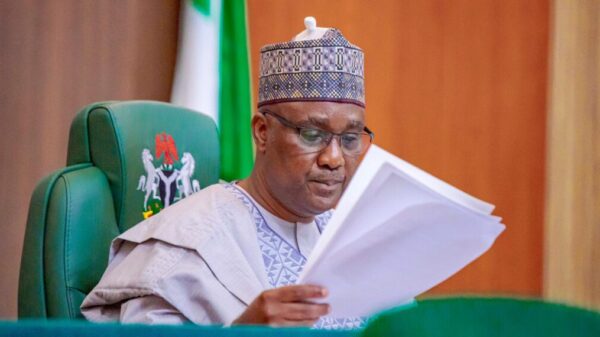



Ogun State Governor, Prince Dapo Abiodun, has formally presented the 2026 Appropriation Bill valued at N1.66 trillion to the State House of Assembly, marking a major step toward advancing his administration’s economic agenda and long-term development vision. The budget proposal, unveiled on Wednesday at the Assembly Complex in Abeokuta, has been tagged the “Budget of Sustainable Legacy”, signifying a focus on strengthening the state’s economic foundation while accelerating investments in infrastructure, social services, and institutional reforms.
The proposed budget represents a 57% increase over the N1.055 trillion approved for the 2025 fiscal year. Governor Abiodun explained that the sizable growth in expenditure reflects both the ambitious revenue outlook of the state and its strategic priorities, especially in industrial expansion, infrastructure modernization, and human capital development.
Capital and Recurrent Expenditure Framework
In his budget presentation, the governor highlighted the fiscal structure of the 2026 spending plan, demonstrating a strong emphasis on capital investments. Out of the total N1.66 trillion:
-
N1.044 trillion, representing 63%, has been earmarked for capital expenditure
-
N624.76 billion, equivalent to 37%, has been allocated for recurrent expenditure
The recurrent component, which covers the cost of running government institutions, is further broken down as follows:
-
Personnel costs: N167.92 billion
-
Public debt charges: N99.98 billion
-
Overhead costs: N291.06 billion
Governor Abiodun emphasized that the dominant allocation to capital projects underscores his administration’s focus on long-term economic gains, job creation, and improved public services across the state.
Revenue Composition and Funding Sources
To finance the 2026 budget, the governor outlined a blend of internally generated revenue, federal allocations, and capital receipts. A key focus is boosting the state’s internal revenue base, in line with the administration’s broader strategy to minimize dependence on federal allocations.
According to the proposal:
-
N250 billion is projected to come from the Ogun State Internal Revenue Service (OGIRS)
-
N259.88 billion is expected from other Ministries, Departments, and Agencies (MDAs)
This brings the projected Internally Generated Revenue (IGR) to a total of N509.88 billion.
In addition, the state anticipates N554.81 billion in federal revenue through statutory allocations, Value Added Tax (VAT), and other shared receipts. A further N518.90 billion will be sourced through capital receipts, including internal and external loans as well as development grants.
Sectoral Priorities and Allocations
Governor Abiodun presented a detailed breakdown of sectoral spending, reflecting his administration’s development priorities:
-
Infrastructure: N526.15 billion (32%)
-
Education: N275 billion (17%)
-
Health: N210.59 billion (13%)
-
Housing & Community Development: N166.96 billion (10%)
-
Social Protection: N72.82 billion (4%)
-
Recreation, Culture & Religion: N42.24 billion (3%)
-
Agriculture & Industry: N40.54 billion (2%)
He stated that infrastructure development, including roads, industrial parks, and energy access, remains central to the administration’s plans for economic growth and investment attraction. Allocations for education and health also reflect an expanded push to improve access to quality learning and medical services.
Economic Outlook and Commitment
Despite macroeconomic pressures—ranging from inflation to forex challenges—Governor Abiodun expressed confidence in the state’s economic trajectory. He noted Ogun’s position as one of Nigeria’s leading contributors to non-oil revenue and described the state as a top industrial hub with strong policy continuity and administrative efficiency.
“Our administration remains steadfast in building a strong and productive economy, empowering citizens, and promoting inclusive development,” he said.
Legislative Collaboration
Responding to the presentation, the Speaker of the House of Assembly, Rt. Hon. Oludaisi Elemide, pledged full legislative cooperation to ensure expedited review and passage of the budget. He reaffirmed the Assembly’s commitment to supporting both the executive and judiciary arms of government in advancing the state’s development agenda.
Long-Term Revenue Ambitions
The budget presentation follows recent disclosures that Ogun State is setting an ambitious target to generate N500 billion in IGR for the 2026 fiscal year. According to the governor, the ultimate goal is to expand annual IGR to N750 billion by 2027, leveraging the state’s industrial base, proximity to Lagos, and strategic infrastructure projects currently underway.
Abiodun stated that the administration aims to use the next two fiscal years to entrench a sustainable revenue framework, deepen private-sector partnerships, and ensure that Ogun remains competitive both nationally and internationally.